Your Personal Trainer Schedule: A Blueprint for 2026
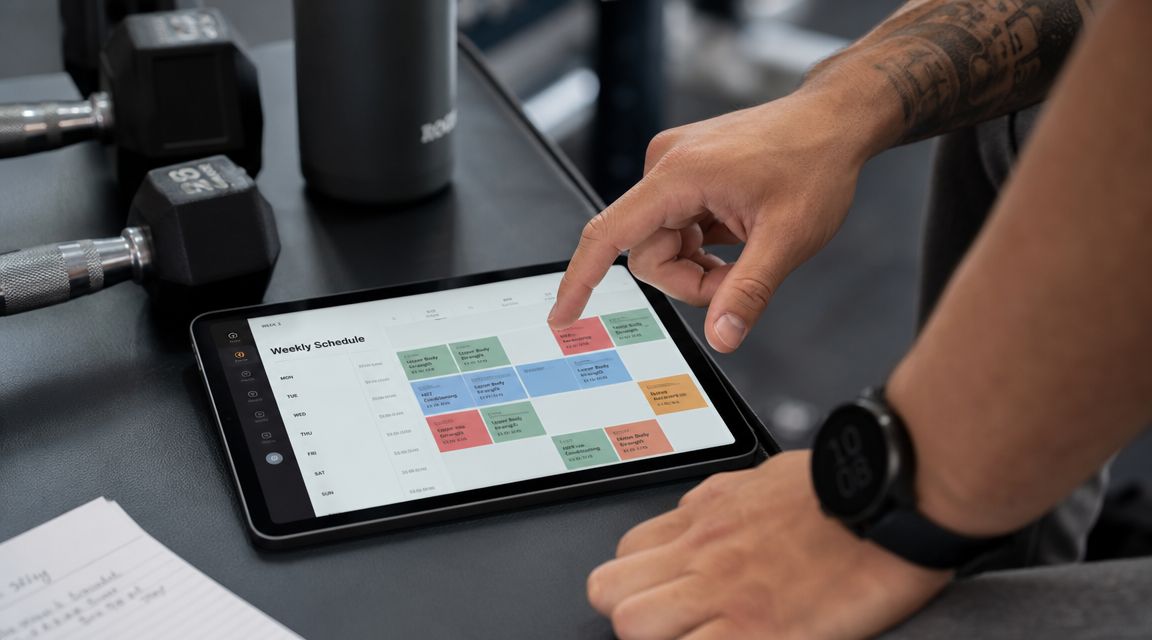
It's 9:15 p.m. You're still answering texts, trying to reshuffle a 6 a.m. client, and your day somehow feels both overbooked and unstable. That's the personal trainer schedule problem in real life. It's not just a calendar issue. It's retention, income protection, energy management, and whether you still want to do this work a year from now.
Most coaches don't need more hustle. They need a schedule that stops bleeding time through gaps, reschedules, unclear policies, and low-frequency clients who never build momentum. If your week feels reactive, your business probably is too.
Table of Contents
Your Schedule Is Broken and It's Not Your Fault
A lot of trainers think they have a discipline problem when they really have a structure problem.
Your workday wasn't designed around a clean office rhythm. It was built around when clients are free. NASM's breakdown of a trainer's day shows the usual pattern clearly: work often starts around 4:30 to 5:00 a.m., the first major client block runs 6:00 to 9:30 a.m., then admin, messaging, and consultations fill the middle of the day, followed by another peak block from 4:30 to 7:30 p.m.. It also notes that many trainers are still checking messages into the evening and may not wind down until around 9:30 to 10:00 p.m. according to NASM's day-in-the-life breakdown.
That matters because a fragmented day creates fake free time. You might have a gap from 11 to 2, but if that gap is filled with programming edits, check-ins, reschedules, consult calls, and clients asking to move sessions, you're not off. You're on, just unpaid and distracted.
Practical rule: Stop treating the spaces between sessions as spare time. They are work blocks, and if you don't label them, clients will claim them.
Claim your week before clients do
Most scheduling problems start with one bad habit. You offer availability before you define boundaries.
A strong personal trainer schedule starts with fixed limits around three things:
Your coaching windows. Decide when you will train people, not when you theoretically could.
Your admin windows. Messages, check-ins, programming, and payment follow-up need a home.
Your off-limits time. Training yourself, family time, rest, and non-client commitments belong on the calendar first.
If you skip that step, every request feels urgent. Every regular wants an exception. Every late reschedule turns into your problem.
Two weekly blueprints you can actually use
Start with a hard reset this week:
Audit the last 14 days. Highlight every session, every admin task, and every time you answered messages outside your intended hours.
Circle your leak points. Most trainers find the same issues: midday drift, late-night texting, and too many custom exceptions.
Set response hours. Clients don't need instant access to you all day. They need reliable access at known times.
Protect one recovery block. If your week has no protected space, your calendar will keep breaking your energy before it breaks your revenue.
You don't need a perfect week. You need a week that can repeat without frying you.
First, Build Your Non-Negotiable Boundaries
Before you hand out a single slot, build the frame that holds your business together. A personal trainer schedule works best when it's programmed with the same intent you use in client training. Stress, recovery, output, and repeatability all matter.

The labor side of the job renders effective scheduling imperative. The U.S. Bureau of Labor Statistics notes that fitness trainers often work variable schedules including nights and weekends, and reports a median hourly wage of $22.20 in May 2024, which means every cancelled or unfilled slot hits directly according to the BLS occupational outlook for fitness trainers and instructors.
Claim your week before clients do
Start by blocking these first, in this order:
Personal commitments first. Your own training, school pickup, family dinner, therapy, and appointments go in before client sessions.
Deep work next. Programming, onboarding, and progress reviews need uninterrupted time, not leftovers.
Prime-time coaching after that. Reserve your most in-demand hours for your highest-value work.
Buffers last. Build transition space around sessions so one late finish doesn't wreck the next three appointments.
If you're newer in the industry and still tightening up the business side, it helps to review the basics of positioning, qualifications, and setup in this guide to personal trainer requirements.
Two weekly blueprints you can actually use
Here are two simple boundary maps that work well for solo coaches.
Template | Best for | Main strength | Main risk |
|---|---|---|---|
Hard Open Hard Close | Trainers who need strict work-life separation | Clear client expectations | You may turn away odd-hour requests |
Peak Window Only | Coaches who want fewer total hours on-site | Protects energy and reduces drift | Midday clients may not fit |
Use them like this:
Hard Open Hard Close
Open for clients in the morning.
Close messaging during your midday work block.
Reopen for evening sessions.
Stop all client communication at a fixed time.
Peak Window Only
Train only during your highest-demand windows.
Keep consults and admin inside one contained daytime block.
Don't sprinkle one-off sessions into dead space just because the slot exists.
A strong schedule doesn't mean you're available more often. It means clients know exactly when you are available and respect it.
If a time block isn't worth repeating every week, don't build your roster around it.
Choose Your Weekly Scheduling Template
A blank calendar invites chaos. You need a model.
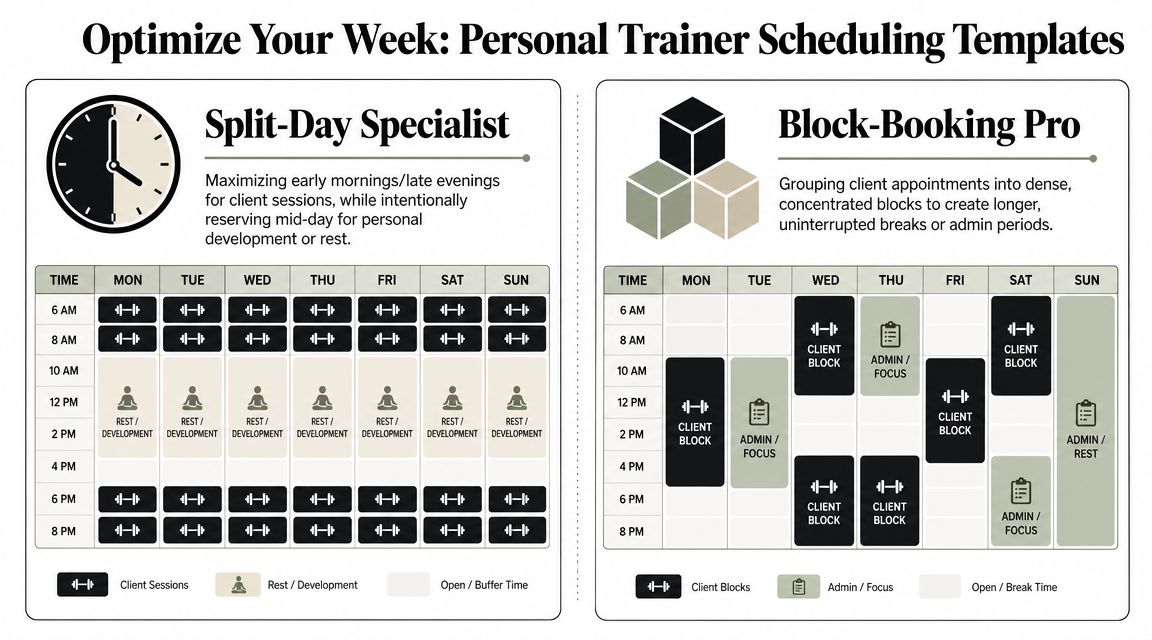
The right personal trainer schedule template depends less on motivation and more on how you want your coaching week to feel. Some trainers do well with split days because they want midday freedom. Others hate the stop-start rhythm and need denser blocks to stay sharp.
If you're evaluating software while rebuilding your calendar system, this overview of gym schedule software can help you think through booking logic, client access, and admin flow.
The Split-Day Specialist
This fits trainers who accept that early mornings and evenings are where demand lives and want to use the middle of the day deliberately.
What works:
Use morning and evening for sessions only
Keep midday for consults, programming, content, and recovery
Avoid casual midday bookings that break your reset block
What doesn't work:
Taking one random noon client because you “can fit it in”
Letting admin spill across the entire middle of the day
Using the gap for low-value tasks that leave you mentally half-on all day
This template is strong if you like two clear performance windows and can protect the middle.
The Block-Booking Pro
This fits trainers who want concentrated coaching blocks and fewer transitions.
Build it around clusters. Stack similar session types together. Group assessments with assessments, recurring clients with recurring clients, and online work into one contained admin block. The point isn't to make the week look busy. It's to make it flow.
A block-booking week usually feels better when:
You dislike fragmented attention
You coach both in-person and online
You want longer uninterrupted breaks rather than short gaps
You need cleaner boundaries around messaging
How to decide which one fits
Ask three questions:
Where does your best coaching happen? If your energy is strongest in two sharp windows, split days may suit you.
How much context switching can you tolerate? If reschedules and short gaps fry your focus, book in dense blocks.
What are you selling? If you sell a lot of recurring in-person sessions, block density matters more than calendar flexibility.
Strong scheduling policies don't make you harder to work with. They make your service easier to trust.
Pick one template and run it for a full month before changing it. Most trainers switch too early, then blame the template instead of the lack of consistency.
Implement Policies That Protect Your Income
A calendar without policy is just optimism.
Many coaches are too soft. They want to be accommodating, so they keep making exceptions. Then they wonder why the week feels unstable and why clients treat prime-time sessions like placeholders instead of commitments.

A coaching source aimed at trainers puts a useful benchmark on retention at roughly 65% to 70%, and also points out that clients often expect visible results in 2 to 3 weeks even though visible progress usually takes 6 to 8 weeks for beginners, as discussed in this trainer retention and expectation-setting video. That gap between expectation and reality is exactly why your schedule and your policies need to support adherence.
If you want payments to stop riding on memory and manual follow-up, tighten the business side with recurring billing. This walkthrough on how to set up recurring payments is worth reviewing while you rebuild your system.
Why frequency and policy have to work together
The same trainer-focused source argues that many coaches underbook clients at one to two sessions per week and then expect results and retention to hold. In practice, sparse schedules usually create weak accountability, slower visible change, and more room for clients to drift.
Your policies should reinforce the service model you believe in:
Recurring appointments beat ad hoc booking
Clear cancellation windows beat negotiation by text
Documented expectations beat vague verbal agreements
Milestone reviews beat waiting for clients to raise concerns
Copy you can use with clients
Keep your policy language plain:
Sessions cancelled with less than 24 hours' notice are charged in full. That protects reserved coaching time and keeps scheduling fair for every client on the roster.
For sickness and genuine emergencies, decide the rule in advance. Don't improvise based on how persuasive the message sounds.
A clean policy stack looks like this:
Cancellation rule. State the notice window and what happens if they miss it.
No-show rule. Define whether the session is forfeited.
Reschedule rule. Explain what counts as enough notice to move a session.
Waitlist rule. If a slot opens, offer it through one process, not a dozen individual texts.
Clients usually respect boundaries when they hear them early, see them in writing, and experience them consistently.
Systematize Session Frequency for Better Results
The fastest way to weaken a personal trainer schedule is to let clients book whenever they feel motivated. That creates unstable revenue for you and inconsistent input for them.
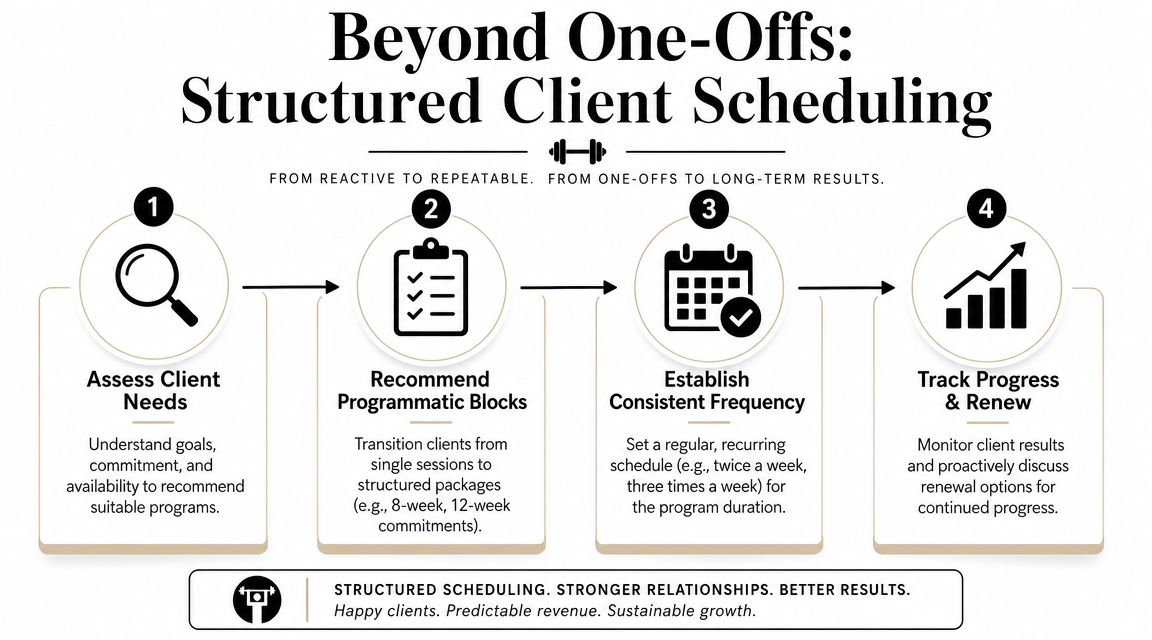
A better model is simple. Sell a training rhythm, not random access.
A controlled 12-week study gives useful support here. All groups followed the same program of three sessions per week for 12 weeks, with aerobic work added after resistance training. The trainer-guided group showed a significant fat reduction of 1.61 kg from baseline and stronger nutrition tracking compliance, according to the study on personal trainer supervision and adherence.
If you want your programming, delivery, and schedule to line up, this exercise programming template helps organize the coaching side around a repeatable client plan.
Stop selling random appointments
One-off sessions make sense in a few cases, like assessments, technique tune-ups, or short-term travel clients. They are a weak default model for a results-driven roster.
Better structure looks like this:
Book by recurring weekly cadence. Put clients into fixed weekly appointments.
Sell in defined blocks. A calendar works better when the commitment period is clear from day one.
Review progress inside the block. Don't wait until motivation drops.
Renew before momentum fades. Rebooking should happen while the client is still engaged.
The schedule should act like a coaching intervention. It should reduce decision fatigue, not create more of it.
What to build into a 12-week rhythm
A simple framework:
Phase | Scheduling focus | Coach priority |
|---|---|---|
Weeks 1 to 4 | Lock attendance and routine | Technique, baseline habits, consistency |
Weeks 5 to 8 | Protect momentum | Progression, feedback, expectation management |
Weeks 9 to 12 | Review and renew | Outcome review, next-block planning |
That's not rigid periodization advice. It's business logic applied to adherence. Fixed cadence helps clients show up often enough to learn, adapt, and stay bought in.
Automate the Admin and Get Back to Coaching
Manual scheduling breaks down in predictable ways. Missed confirmations. Payment chasing. Notes in one app, bookings in another, and reschedules buried in text threads. None of that makes you a better coach.
It just turns you into your own front desk.

Adherence is the bigger issue anyway. Only 24.2% of U.S. adults met both aerobic and muscle-strengthening activity guidelines in 2020, which is why scheduling needs to act as behavior design, not simple admin, as noted in this discussion of movement, motivation, and adherence. Reminder systems and easy booking matter because clients are inconsistent long before they are officially cancelled.
If your onboarding still lives across forms, DMs, and calendar invites, review this breakdown of best client onboarding software.
What to automate first
Don't automate everything at once. Start with the tasks that steal time repeatedly.
Booking confirmations
Set automatic confirmation when a client books.
Make sure they can see the time, location, and any session instructions without asking you.
Reminders
Stop sending manual “still good for tomorrow?” texts.
Use reminders to reinforce attendance and give clients a clear action path if they need to reschedule.
Recurring appointments
Put long-term clients into repeating slots instead of rebuilding the week manually.
This reduces friction for both sides and exposes real capacity faster.
Payments
Remove awkward post-session chasing.
Tie payment to the service model so revenue collection doesn't depend on memory.
Client records
Keep notes, messages, progress photos, and session history attached to the client, not scattered across tools.
What to set up in the next 24 hours
You can make this cleaner today.
Block your true coaching hours in one calendar.
Write one cancellation policy and send it to every active client.
Move your top recurring clients into fixed weekly times.
Create one admin block for programming and message replies.
Turn on automated reminders wherever your current system allows.
List every place client info lives. Then start consolidating it.
A lot of coaches hesitate to switch systems because they've already been burned. Prices climbed without warning. Bugs sat there for months. Feedback disappeared into a void after the company got acquired and moved on. That hesitation is fair.
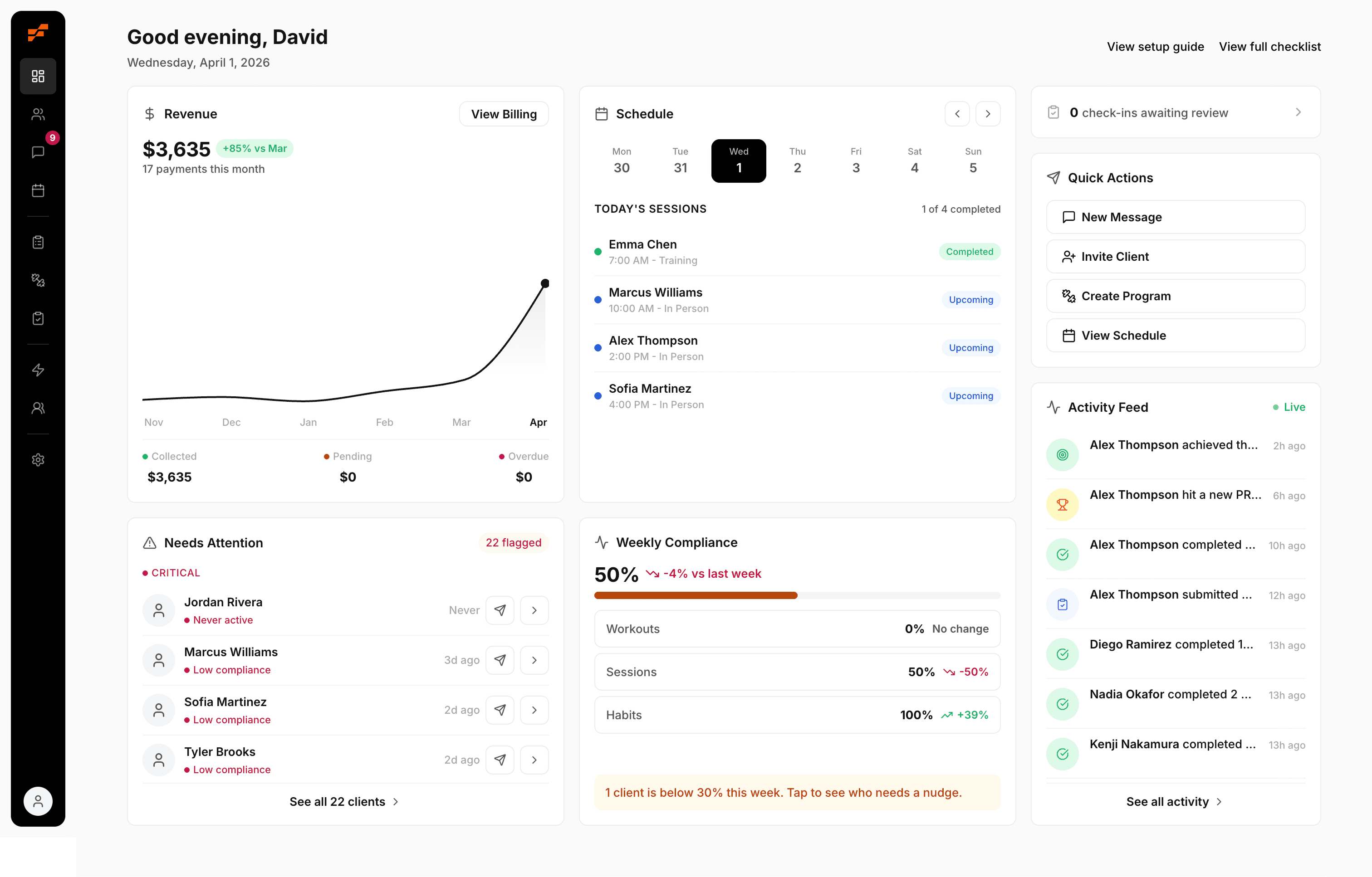
FitCentral is built for that exact coach. It was co-founded by David Spitdowski, a practicing personal trainer who still uses the product with real clients, so the scheduling, reminders, payments, programming, and client management workflows reflect how coaching businesses run. If you want a system that helps you replace patchwork admin with a cleaner personal trainer schedule, see how FitCentral works and start by moving your recurring clients and policies into one place.
See also




Ready to stop fighting your software?
FitCentral gives you everything you need to manage clients, deliver results, and grow your business. Sign up today.