Personal Trainer Requirements: The Pro's Checklist
You’ve probably had this thought after a solid coaching day: the programming is good, clients are progressing, the sessions feel sharp, but there’s still a low-grade anxiety in the background. Not about coaching. About everything around coaching.
You wonder if your certs are enough, if your waiver truly protects you, if you’re crossing a line when a client asks about pain or meal plans, or if your setup would hold up if something went wrong tomorrow. That’s the essential conversation around personal trainer requirements once you’re working with real clients and trying to build something that lasts.
A significant opportunity exists. The U.S. Bureau of Labor Statistics projects 12% employment growth for fitness trainers and instructors from 2024 to 2034, with about 74,200 job openings projected annually according to RunRepeat’s roundup of personal trainer industry data. More demand brings more coaches into the market. The ones who last won’t just be good at cues and programming. They’ll be the ones who look professional, coach inside their lane, and run a business clients trust.
Table of Contents
More Than Just Reps and Sets
The Foundational Pillars Certification and Preparedness
What counts as a real starting point
Why credentials affect retention
What preparedness actually looks like
Building Your Professional Shield
Protect the business before you need to
What your client paperwork should do
A simple decision lens
Defining Your Professional Boundaries
What stays in your lane
What to say when a client asks for more
Boundaries build better businesses
Systems for Scaling Beyond 10 Clients
The admin load that catches good coaches off guard
The minimum systems a solo coach needs
What actually works
Your 24-Hour Professionalism Action Plan
Do these today
Use this as your standard going forward
More Than Just Reps and Sets
A lot of good trainers get stuck here. They know how to coach a hinge, adjust volume, and keep a client moving forward through a rough week. Then they go home and feel less certain about the business side than they want to admit.
That uncertainty doesn’t mean you’re unqualified. It usually means you’re starting to think like an owner instead of a session-to-session freelancer.

The shift matters. A trainer who treats requirements like annoying paperwork usually stays reactive. A trainer who treats them like operating standards coaches with more confidence, charges more cleanly, and attracts better clients because everything feels tighter.
Here’s what that looks like in practice:
A certification isn’t just a logo on your bio. It tells clients and facilities you’ve met a baseline.
CPR/AED isn’t just compliance. It changes how seriously people take your duty of care.
A waiver isn’t just legal padding. It sets expectations before the first hard conversation.
A business structure isn’t just admin. It separates your work from your personal life in ways that matter when money and liability get real.
Practical rule: If a requirement reduces confusion, protects income, or improves trust, it’s part of coaching. Not separate from it.
Most coaches don’t lose momentum because they forgot how to write a program. They lose momentum because their operation stays loose while their client count grows. A few clients can live inside notes apps, text threads, and a waiver you downloaded years ago. A real business can’t.
That’s why personal trainer requirements are better viewed as your floor, not your ceiling. They create the conditions for consistent coaching. They also make referrals easier, because people trust a coach who looks organized and prepared.
If you want a wider view of the business side coaches often miss, FitCentral’s blog for personal trainers and fitness coaches is worth keeping in your reading rotation.
The Foundational Pillars Certification and Preparedness
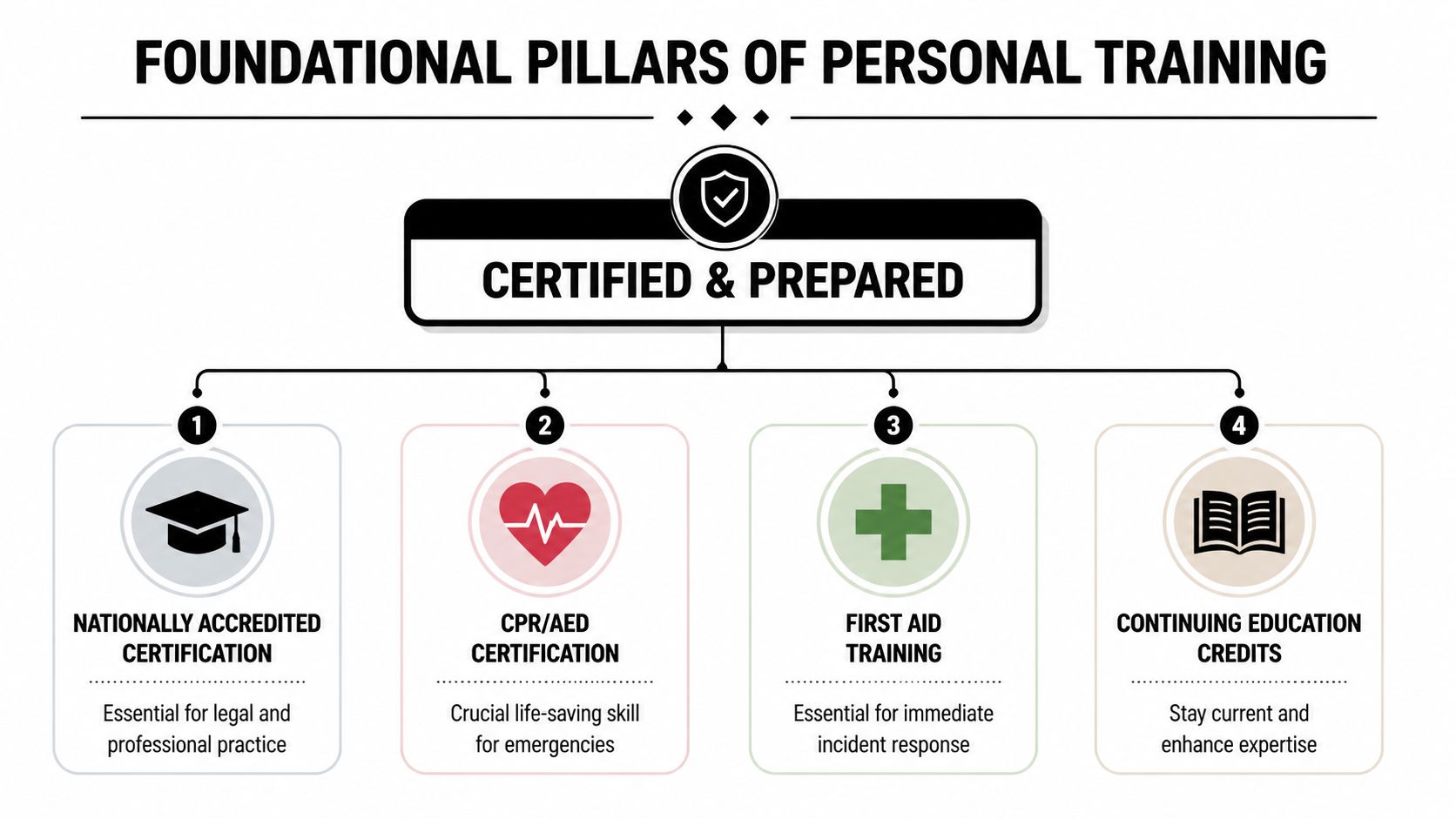
You don’t need every credential in the industry. You do need the right baseline. That means a recognized certification, current emergency readiness, and a habit of continuing education that improves your service.
What counts as a real starting point
For most independent coaches, the basic professional stack looks like this:
A recognized personal training certification
This is the first trust marker clients and facilities look for. It shows you’ve studied movement, program design, anatomy, and the core decision-making that keeps clients progressing safely.Current CPR/AED certification
This is essential. If you’re working with people in person, especially deconditioned clients or higher-risk populations, emergency prep is part of the job.Basic first aid knowledge
It won’t replace medical care, but it improves your response when small incidents happen and helps you stay calm under pressure.Continuing education that matches your roster
If you coach postnatal clients, gen pop fat loss, strength-focused adults, or hybrid clients, your education should reflect that. Random letters after your name don’t help if they don’t sharpen delivery.
A common mistake is treating certification like a one-time hurdle. It’s better to treat it like the baseline language of the profession. Clients may never ask which chapter covered biomechanics, but they’ll feel the difference when your exercise selection, regressions, progressions, and session flow make sense.
Why credentials affect retention
Industry data shows 22.6% of fitness members work with personal coaches, and trainers with recognized credentials see stronger retention. Proper certification supports precise programming, which correlates with 15% to 25% higher retention rates in major markets like the US and UK, according to NESTA’s guidance on fitness trainer requirements.
That tracks with what most experienced coaches see on the floor. Clients stay when the plan feels individualized, progression feels intentional, and they can tell you’re not guessing.
A credential should help you do things like:
Write clear progressions: The client knows why load, reps, tempo, or exercise selection changed.
Manage fatigue: You don’t push hard sessions blindly when sleep, stress, or soreness says otherwise.
Coach technique with purpose: You give cues that solve the problem in front of you, not generic noise.
Adjust the plan early: You catch a plateau before the client starts doubting the process.
Credentials don’t retain clients by themselves. Better decisions do.
What preparedness actually looks like
Preparedness is less about having a certificate on file and more about being current enough to act well under pressure.
Use this quick self-audit:
Requirement | What good looks like |
|---|---|
Certification | Active, recognized, easy to verify |
CPR/AED | Current card, renewal date already tracked |
First aid | You know what you’d do in a minor incident |
Continuing education | Directly tied to your client population |
If your cert is active but your practical standards are loose, clients will feel that. If your cert is active and your coaching systems are sharp, clients feel safer from day one.
Building Your Professional Shield
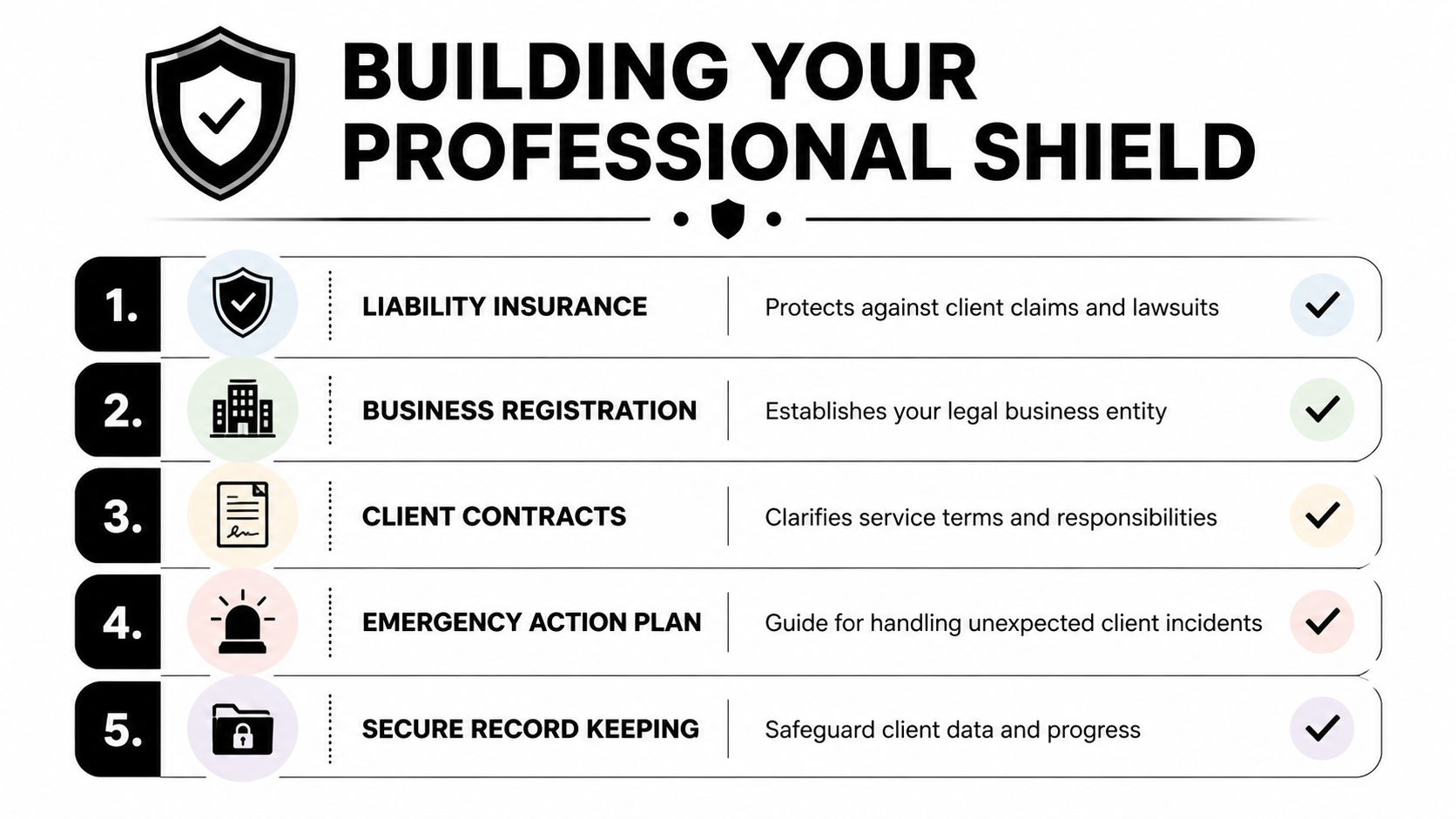
If you’re coaching independently, legal and operational protection isn’t a side project. It’s part of being a professional. Good coaches sometimes resist this because it feels cold or overly formal. In reality, it’s what lets you coach hard, communicate clearly, and sleep better.
Protect the business before you need to
You want protection in place before a client gets hurt, disputes a charge, or claims you promised something you didn’t.
The core pieces are straightforward:
Liability insurance
If you train real humans, you need it. Insurance doesn’t make you careless. It gives you a layer of protection if a claim comes your way.Business registration
Whether you operate as a sole proprietor or form an LLC depends on your situation, local rules, tax advice, and risk tolerance. What matters is choosing deliberately instead of drifting into business ownership by accident.Emergency action plan
Know what happens if a client faints, gets injured, or has an acute issue during a session. Who do you call, what do you document, and what comes next?Secure record keeping Health history, PAR-Q style intake, progress notes, payment records, and communication history should be stored in a way you can access and defend if needed.
A lot of trainers wait until they “have more clients” to do this properly. That’s backward. The clients you already have are enough reason.
A professional setup doesn’t signal fear. It signals standards.
What your client paperwork should do
Your paperwork shouldn’t be copied from three random templates and stitched together the night before onboarding. It should answer the questions that usually become problems later.
Your client agreement should cover:
Services provided Spell out what the client is buying. In-person sessions, programming, check-ins, messaging access, nutrition guidance within your scope, or some combination.
Payment terms
State when payment is due, how recurring billing works, and what happens if payment fails.Cancellation and rescheduling
Your policy needs teeth. If you don’t define the window clearly, clients will define it for you.Refund policy
Be specific. Ambiguity creates arguments.Coaching boundaries
Note what you do and don’t provide, especially around medical advice, diagnosis, and treatment.Assumption of risk and informed consent
Clients need to acknowledge the physical nature of training and the responsibilities on both sides.
If you want your front-end presentation to match that level of professionalism, even details like your branding and handouts matter. This guide to fitness trainer business cards for coaches is a useful reminder that small professional signals stack up.
A simple decision lens
When you’re deciding whether a policy or document is worth the effort, ask:
Does this protect me?
Does this clarify expectations?
Does this make the client experience cleaner?
If the answer is yes to even two of those, it belongs in your business.
Defining Your Professional Boundaries
A lot of personal trainer requirements live in your scope of practice, not on a certificate. This reality distinguishes smart coaches from reckless ones.
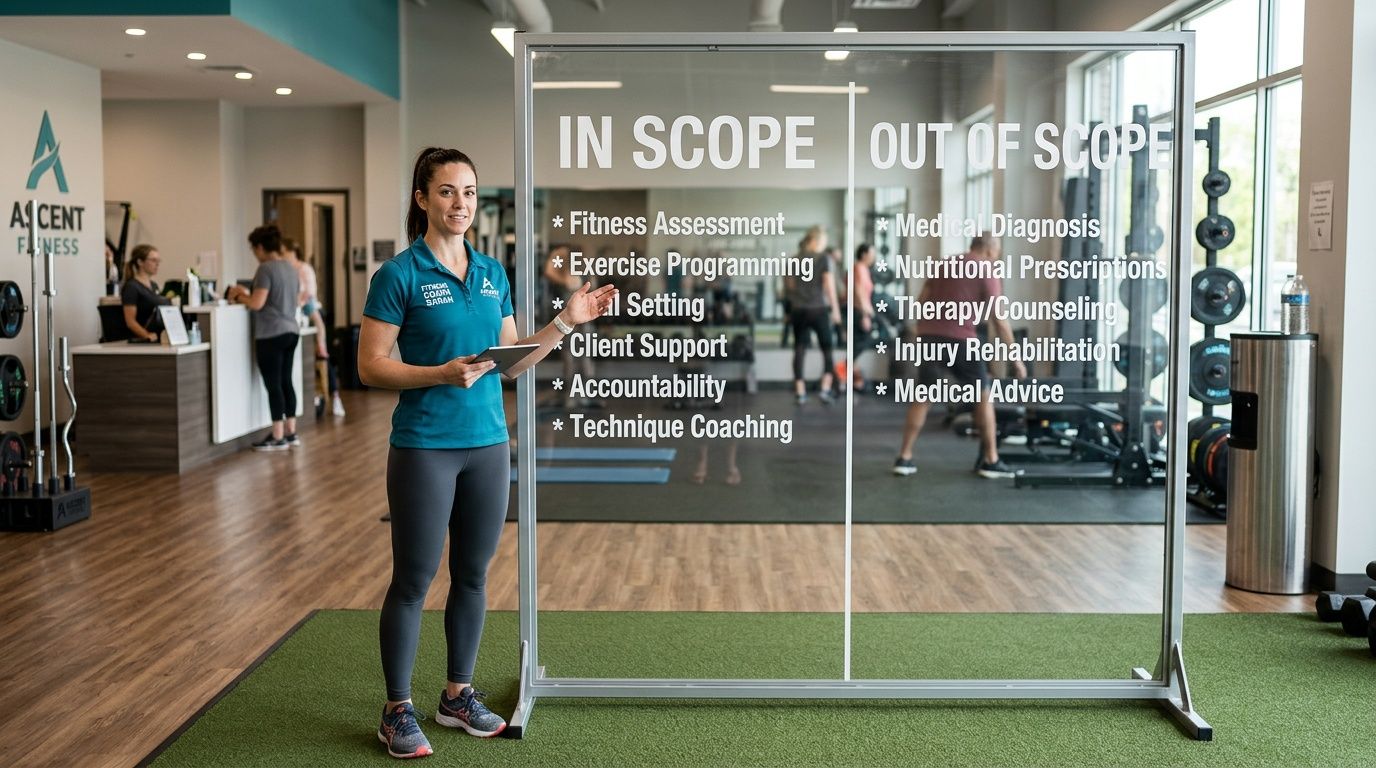
If you coach long enough, clients will ask you for things outside your lane. They’ll ask whether a sharp knee pain is “just tightness.” They’ll want a meal plan for a medical condition. They’ll ask if they should stop medication, train through numbness, or use supplements a certain way.
Your job isn’t to sound helpful at all costs. Your job is to be useful without pretending to be a clinician.
What stays in your lane
Here’s the practical divide.
Within your scope:
General exercise instruction
Program design and progression
Habit coaching
General nutrition education
Lifestyle support around consistency, recovery, and adherence
Referring out when a problem needs another professional
Outside your scope:
Diagnosing an injury
Treating pain conditions
Prescribing nutrition to manage disease
Giving medical advice
Interpreting symptoms as if you’re a physician or physical therapist
Clients usually trust you more when you’re honest about that line. Not less.
The coach who says “that’s outside my lane, let’s get the right person involved” sounds more credible than the coach who improvises.
A good habit is to build a referral bench before you need one. Know a physical therapist, registered dietitian, physician, and maybe a mental health professional you trust. When a client issue moves beyond coaching, the handoff should feel smooth.
What to say when a client asks for more
You don’t need a stiff script. You need clear language.
Examples:
“I can help you adjust training around that pain, but I can’t diagnose what’s causing it.”
“I can give you general nutrition guidance, but for a condition-specific meal plan, I’d want you working with a registered dietitian.”
“Let’s get medical clearance before we push intensity here.”
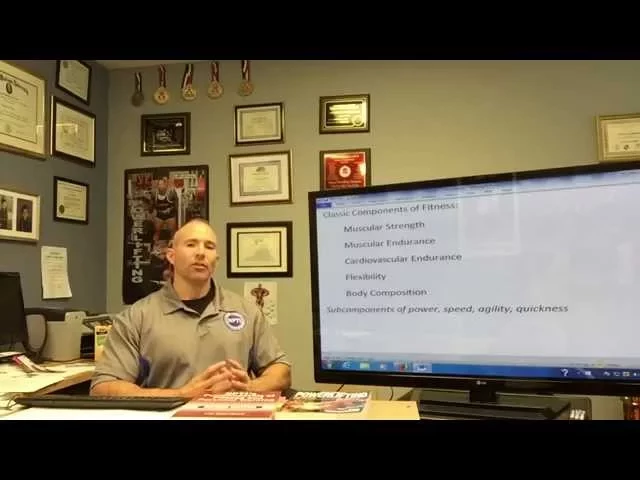
This short video is a useful reminder that professionalism often sounds calm and simple, not complicated.
Your terms should reflect those boundaries too. If you haven’t reviewed the language clients are agreeing to, read through FitCentral’s terms of use for an example of how clear boundaries and responsibilities can be stated plainly.
Boundaries build better businesses
Scope of practice isn’t just about risk. It helps your brand.
When you stay in your lane:
Clients trust your judgment more
Other professionals refer to you more comfortably
You avoid messy promises
Your coaching stays clean and defensible
That’s not playing small. That’s operating like a pro.
Systems for Scaling Beyond 10 Clients
A coach can brute-force a roster of five. Once you move past that, the cracks show fast. Not because your programming got worse, but because the admin work starts stealing the attention your clients pay for.

Many articles on personal trainer requirements fall short. They stop at certification and CPR. That’s necessary, but it won’t help you when you’re chasing late payments, digging through old messages for check-in notes, or rebuilding a client’s program after a spreadsheet broke.
The admin load that catches good coaches off guard
The fitness industry projects 15% job growth through 2032, but 40% of solo trainers report tool-related inefficiencies as their top barrier to scaling, according to PT Pioneer’s discussion of trainer business realities.
That number makes sense because most trainers were taught exercise science, not operating systems.
The common failure points look like this:
Intake lives in one place, notes in another
So every client update turns into detective work.Programming is decent, logging is messy
Clients miss details, forget loads, and stop engaging because the process feels clunky.Scheduling runs through texts and DMs
Your calendar becomes a negotiation instead of a system.Payments happen manually
You waste energy on reminders and awkward follow-ups.Communication is scattered
Important context gets buried in message threads.
Coach’s rule: If you need three tools and your memory to answer one client question, your system is already too loose.
The minimum systems a solo coach needs
You don’t need complexity. You need coverage.
Here’s the practical checklist:
Intake and assessment flow
New client forms, health history, baseline notes, goals, and clear onboarding steps.Programming and workout logging
You should be able to assign complete workouts with sets, reps, tempo, and rest. The client should be able to log training cleanly and see prior performance without friction.Scheduling and reminders
Clients need a way to book or confirm without endless back-and-forth. Automated reminders help reduce no-shows and keep the week stable.Billing and recurring payments
If you’re still sending one-off reminders manually, you’re using coaching energy on collections.Centralized client records
Notes, progress photos, check-ins, habits, and communication should live together.
A lot of coaches know this and still hesitate because they’ve been burned before. They’ve dealt with buggy apps, support that disappears, feature requests that go nowhere, and prices that rise after a platform gets acquired and starts acting like coaches are trapped.
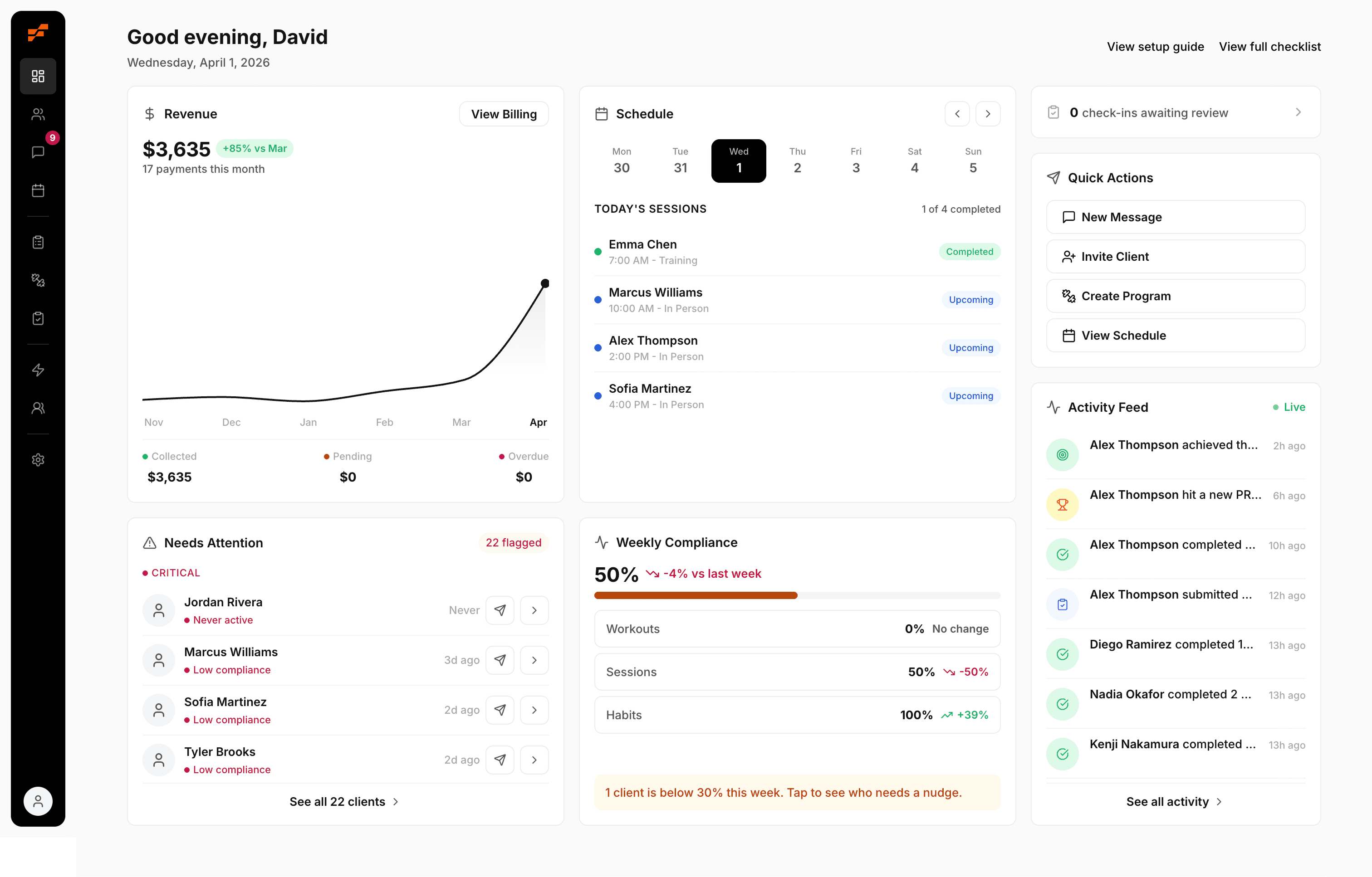
That frustration is exactly why a coach-built system matters. FitCentral was co-founded by David Spitdowski, a practicing personal trainer who uses the product with real clients. That usually leads to better decisions because the builder has felt the same no-show headaches, scheduling issues, and clunky workflow problems the rest of us have.
You can also see the model clearly in FitCentral’s pricing for personal trainers and coaches, which is transparent at $29 per month plus $1 per active client. For coaches who are tired of surprise increases and unclear tiers, that alone removes a lot of friction.
What actually works
What works is boring in the best way. One clean workflow. Fewer moving parts. Less re-entry. Less hunting. Less chasing.
What doesn’t work is trying to look established while running the business off patches and workarounds.
When your systems are tight, clients feel it immediately. Sessions start cleaner, check-ins get answered faster, progress is easier to review, and your attention stays where it should be, on coaching.
Your 24-Hour Professionalism Action Plan
You don’t need a full business overhaul by tomorrow. You do need a tighter standard by tomorrow.
Do these today
Check your expiration dates
Look at your certification and CPR/AED right now. If either is close to expiration, put the renewal date in your calendar before the day ends.Review your intake packet
Read it like a skeptical client. If anything is vague, rewrite it. Especially services, payment terms, cancellations, and expectations.List your referral bench
Write down the names of the health professionals you trust. If you don’t have a short list yet, start one.Audit your client records
Pick three active clients. Can you find their goals, notes, payments, and progress history quickly? If not, your setup needs tightening.Write three scope-of-practice responses
Create your stock language for pain questions, medical questions, and condition-specific nutrition questions. Keep it simple and reusable.Map your client journey
From lead to consult to onboarding to programming to payment, write every step. Anywhere you rely on memory is a weak point.Flag your biggest admin drain
Choose one problem that keeps repeating. Scheduling, no-shows, payment chasing, scattered notes, or workout delivery. Fixing one friction point usually exposes the next useful improvement.
Use this as your standard going forward
A professional business usually feels calmer, not fancier. You aren’t trying to impress other trainers. You’re trying to make your service easier to trust and easier to deliver.
Use this quick standard:
If it protects clients, keep it current
If it protects the business, document it
If it saves time every week, systemize it
If it sits outside your lane, refer out
One more practical move for today, reach out through FitCentral’s contact page for coaches if you want to compare your current workflow against a cleaner setup built for real client management.
If you’re done patching together spreadsheets, chat threads, and payment reminders, take a serious look at FitCentral. It was built for working coaches who need reliable programming, scheduling, client tracking, and payments without the usual tool headaches. The best next step is simple, test your current process against a platform designed by a practicing trainer and see where your business gets easier.
See also



Ready to stop fighting your software?
FitCentral gives you everything you need to manage clients, deliver results, and grow your business. Sign up today.