Hourly Rate Personal Trainer: Price Guide 2026

You finish a strong session. Your client moves better, hits a PR, leaves fired up, and texts later to say they finally feel back on track. Then you look at your week and realize you spent half of it programming, answering messages, chasing payments, and rearranging sessions. The coaching feels high value. Your bank account does not.
That gap is where most independent trainers get stuck. Not because they're bad at coaching, but because they're pricing from guesswork. They copy a local gym's number, match another trainer's session rate, or pick something that “feels fair.” Then they wonder why a full calendar still feels tight.
The fix is a pricing system. You need a defensible hourly rate personal trainer model that covers your costs, reflects your market, and makes sense to clients when you say it out loud. If you're still building toward that, getting clear on personal trainer requirements also helps because better positioning starts with real credentials and a clear service offer.
Table of Contents
Stop Underselling Your Value
A lot of trainers don't have a pricing problem. They have a clarity problem.
They know they're helping clients. They can point to better lifts, better habits, better compliance, and fewer missed weeks. But when it's time to name a rate, they default to whatever sounds least uncomfortable. That usually means they price the session like they're only selling minutes on the gym floor.

That mindset is expensive. The hour in front of the client is only the visible part of the job. The complete service includes assessment, program design, adjustment, follow-up, accountability, and decision-making. If you only charge for face-to-face time, you train hard and still end up underpaid.
What underpricing actually looks like
Underpricing usually shows up in ways trainers recognize immediately:
You hesitate when saying your rate, because you picked it emotionally, not mathematically.
You resent high-maintenance clients, because your price doesn't cover the time they consume outside the session.
You stay “busy” but cash feels thin, because a full week includes too much unpaid labor.
You avoid raises for too long, because you don't have a clear reason behind the number.
Practical rule: if your rate makes sense only when the client is standing in front of you, it's probably too low.
The real job is coaching, not selling hours
A solid hourly rate personal trainer strategy starts by separating value delivered from time observed. Clients don't stay because they bought sixty minutes. They stay because they feel progress, structure, and accountability.
That's why guessing from what another coach posts on Instagram rarely works. Their niche may be different. Their city may be different. Their expenses, split, and service depth may be different. Your pricing has to match your business, not theirs.
The trainers who get paid well consistently aren't always the flashiest. They're the ones who can answer three questions cleanly:
What does it cost me to deliver this properly?
Where do I sit in my market?
How do I package and explain the value without sounding apologetic?
Get those right and pricing stops feeling awkward. It starts feeling professional.
Calculate Your Baseline with the Cost-Plus Method
Before you talk about premium pricing, you need a floor. Not a vibe. Not a number you copied. A real floor.
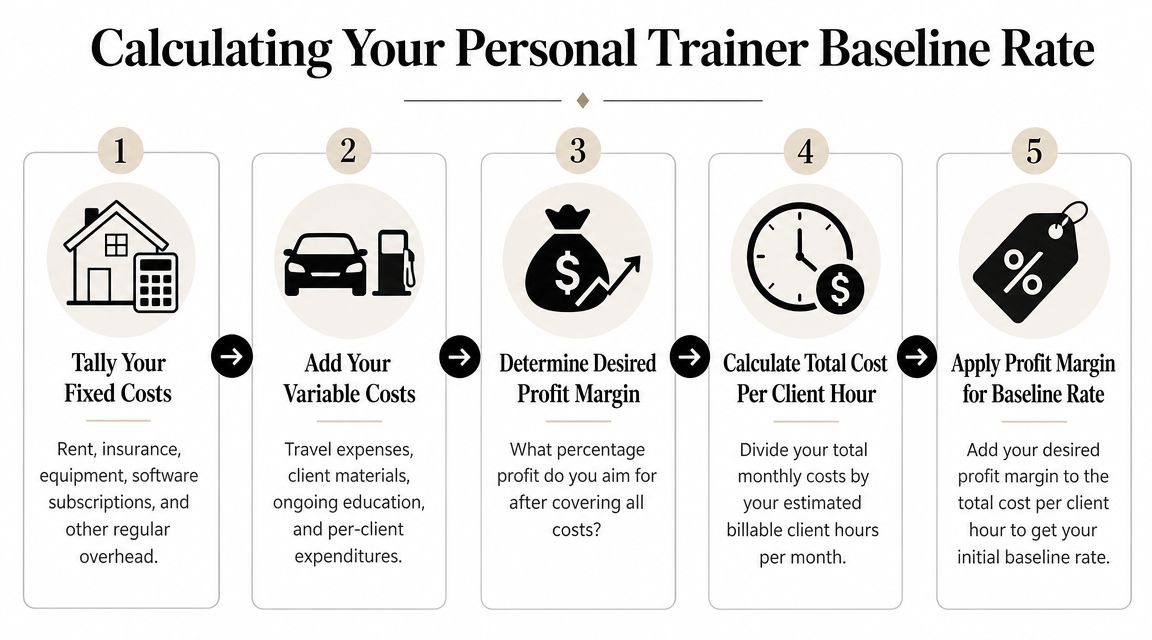
The cost-plus method is simple. Add up what it costs to run your business and your life, decide what you need the business to produce, and divide that by the hours that are billable. Then build margin on top.
Why employed wage data can mislead you
A lot of coaches still anchor themselves to employee wage data, and that's where the math goes sideways. NASM notes that trainers commonly earn about $8.50 to $15.00 per hour for floor shifts, while session delivery can add roughly $15 to $20 per hour on top of that in some gym settings, which is exactly why solo coaches need to separate billable coaching from non-billable work like prep, messaging, and sales in their pricing model, as explained in NASM's breakdown of trainer compensation.
If you're independent, those employee figures aren't your pricing model. They're a warning. They show how easily a headline hourly number can hide unpaid work.
A baseline formula you can use this week
Use this formula:
Baseline session rate = (monthly business costs + monthly personal income need + tax set-aside) ÷ monthly billable coaching hours
Then pressure-test it by asking whether that rate still works after cancellations, dead hours, and time spent outside sessions.
Start with these buckets:
Fixed business costs
Insurance, rent, software, payment processing, continuing education, equipment replacement, phone, internet, and any contractor support.Variable delivery costs
Travel, session materials, niche-specific tools, and client-specific extras.Personal income requirement
Rent or mortgage, groceries, utilities, transport, debt, and savings goals. Your business has to fund your life, not just survive on paper.Tax set-aside
Don't price as if gross income is take-home income. It isn't.Billable hours only
This is the part most trainers inflate. If you work many hours per week but only some are paid sessions, only the session hours count in the divisor.
Most pricing mistakes happen in the denominator. Trainers divide by total working hours, when they should divide by actual billable coaching hours.
How to estimate billable hours honestly
Don't assume every open slot gets sold. Build from your real week.
Ask yourself:
How many sessions can I deliver well? Not theoretically, but while keeping coaching quality high.
How many of those hours are consistently sellable? Midday dead zones matter.
How much time disappears into admin? Programming, check-ins, consults, lead follow-up, reschedules, and payment cleanup all count against your effective rate.
A clean way to work is to review the last month and tag your calendar into two categories:
Billable time
Non-billable time
If your posted hourly rate looks good but your weekly take-home doesn't, the problem is usually hidden in that second category.
Build a floor, then add room to breathe
Your baseline is the minimum sustainable number, not the final offer. Once you know it, add a margin so your business can absorb slow weeks, education costs, and growth.
Use your baseline to make better decisions fast:
Decline bad-fit discounts because you know your floor.
Spot unprofitable clients who require too much unpaid support.
Design packages intentionally instead of discounting randomly.
Raise rates cleanly because you can explain the logic.
If you can't show yourself the math behind your rate, clients will feel that uncertainty even if they can't name it.
Find Your Market Position with Research
Once you know your floor, you need context. Not to copy competitors, but to decide where you belong.
A market position is just the intersection of three things. What clients in your area already expect, what kind of service you deliver, and what kind of client you want more of.

What to research locally
The national median doesn't answer local pricing questions. The U.S. Bureau of Labor Statistics reports a median wage of $22.20 per hour and a median annual wage of $46,180 for fitness trainers and instructors in May 2024, but that figure mixes employment types and settings. For independent trainers in major cities, $100 to $150 per session can be common, which is why location, specialization, and business model matter more than any single national average, as noted by the BLS occupational outlook.
That means your research should be local and practical.
Look at:
Independent trainer sites and note whether they sell single sessions, packs, or monthly coaching.
Studio and private gym offers and compare what's included beyond the workout.
Social content and intake language to see who they serve. General population, athletes, postpartum, fat loss, rehab-adjacent, executives, older adults.
Environment and convenience. In-home, private studio, commercial gym, remote hybrid support.
A useful shortcut is to compare coaches serving the same buyer. If you coach women in perimenopause with strength and habit support, compare yourself to others solving that same problem. Don't compare yourself to a general gym-floor trainer posting walk-up session rates.
What lets you charge more
Premium pricing isn't random. It usually comes from a combination of sharper positioning and stronger service delivery.
Here's what tends to move your pricing power upward:
A clear niche
General fitness is harder to price at the top end. Specific populations create clearer value.Relevant credentials
Extra letters only matter when they connect to the client's problem. A nutrition-focused coach can study how strong specialists frame their authority by reviewing examples from top nutrition coaches.Better service depth
Programming, accountability, habit support, and progress review make your offer harder to compare to a basic session.A better client experience
Smooth scheduling, clean communication, and professional systems support a higher rate because they reduce friction.
If your service is easy to compare, it's easy to price-shop.
The goal isn't to be the cheapest option or the most expensive one. The goal is to make your rate make sense for the kind of result and experience you provide.
Package Your Services Beyond the Hourly Rate
Selling one session at a time sounds flexible. In practice, it often creates flaky commitment, unstable income, and constant negotiation.
If you want a stronger business, stop treating the session as the whole product. The session is one delivery mechanism inside a coaching offer.
Why single sessions keep you stuck
Single-session pricing invites short-term thinking from both sides. The client thinks in workouts. You need them thinking in outcomes, consistency, and adherence.
That shift matters because the market is already moving beyond pure hourly billing. Many online fitness programs now cost about $100 to $200 per month and often include programming and accountability, while in-person rates are commonly framed around coaching relationships rather than isolated sessions, which supports a monthly model when your service goes beyond face-to-face time, as described in NESTA's pricing guide for U.S. trainers.
If your service includes check-ins, habit review, plan adjustments, and between-session support, hourly-only pricing leaves money on the table.
Three packaging formats that work
Most independent coaches do best with a ladder, not a single offer.
Single-session rate as your highest unit price
Keep it available if you want, but don't make it the obvious choice. It's best for trial sessions, irregular travelers, or occasional technique work.Session packs for committed in-person clients
Packs improve retention and simplify cash flow. They also reduce the “should I train this week?” decision that kills momentum.Monthly coaching retainers for hybrid delivery
This is usually the strongest model when your work includes both sessions and support outside sessions. It prices the relationship, not just the hour.
Comparing personal training pricing models
Model | Best For | Pros | Cons |
|---|---|---|---|
Single session | New leads, occasional clients, technique tune-ups | Easy to understand, low barrier to entry | Caps income, weaker commitment, more cancellations |
Session pack | Regular in-person clients | Better cash flow, stronger buy-in, easier scheduling | Still tied closely to attendance volume |
Monthly retainer | Hybrid or high-touch coaching | Predictable revenue, better reflects full service, stronger adherence | Requires clearer boundaries and better systems |
If your website still presents training as a menu of isolated appointments, it's harder to sell continuity. A better structure is to frame offers around transformation and support. That's easier when your messaging and sales flow are built with a proper website for personal trainer businesses in mind.
How to package without confusing clients
Keep the offer simple enough to explain in one breath.
For example:
One-off for assessment or occasional form work
Pack for clients who want a fixed number of in-person sessions
Monthly coaching for clients who want full support, structure, and accountability
The more support you provide outside the session, the less sense it makes to bill like a freelancer selling time blocks.
A lot of trainers undercharge because they're still naming the product after the appointment. Rename it around the result and service scope. That one change alone often makes rate conversations easier.
Communicate Your Rates and Handle Objections
Most pricing conversations go wrong before the number comes up. The trainer starts with logistics, rushes to the rate, and tries to defend it after the client reacts.
A better sequence is simple. Diagnose first. Prescribe second. Price third.
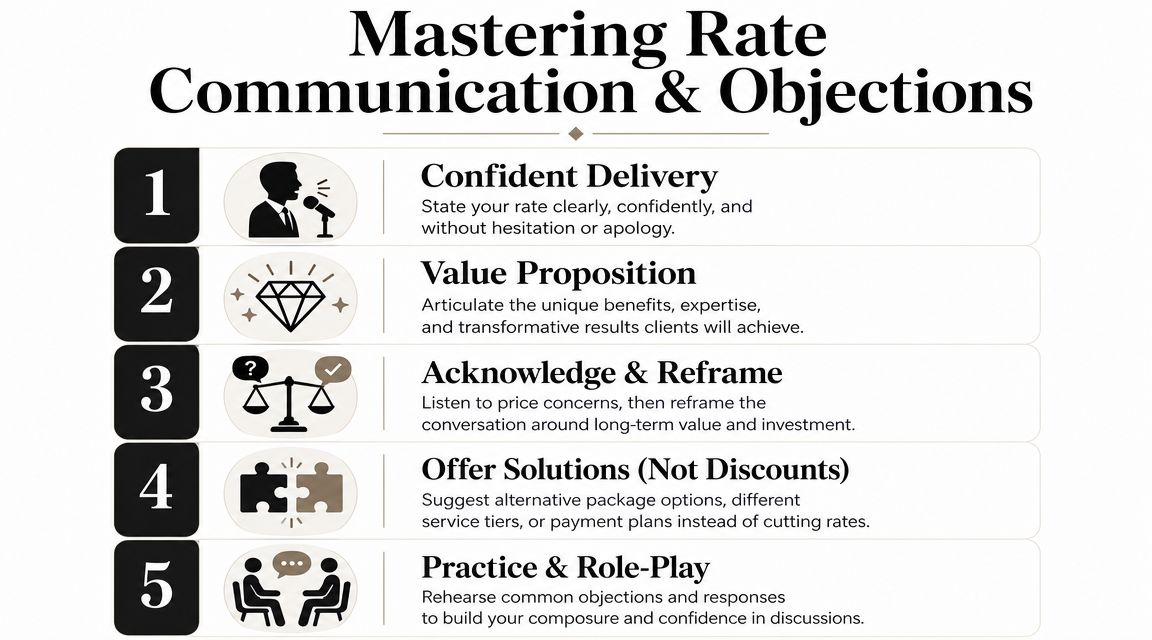
Lead with outcomes, not the rate
When clients understand what your coaching changes, price lands differently. A 12-week study found that the group guided by a personal trainer showed a significant fat-reduction change of -1.61 kg and a 47% increase in squat performance, with better adherence to nutritional planning and stronger injury-prevention effects than unsupervised comparison groups, according to this trainer-guided outcomes study.
That's the frame. You're not selling supervised reps. You're selling structure, adherence, and better execution over time.
Try this consult flow:
Clarify the goal
“What are you trying to change over the next few months?”Surface the obstacle
“What's been getting in the way so far?”Explain the coaching plan
“Here's how I'd structure this based on what you told me.”Present the offer cleanly
“The best fit is my monthly coaching option.”
No apology. No rambling. No discount language before they ask.
Scripts for common objections
Use calm, short answers. The longer you talk, the more uncertain you sound.
If they say, “That's more than I expected.”
Say: “I get that. It's common to compare training by the hour, but my coaching includes the work between sessions too, because that's usually where consistency and results are won or lost.”
If they say, “Do you offer discounts?”
Say: “I don't reduce the rate for the same service. What I can do is point you to a simpler option that fits your budget better.”
If they say, “Another trainer is cheaper.”
Say: “That may be true. The question is what's included, who it's built for, and how much guidance you want between sessions.”
If they say, “Can I just pay session by session?”
Say: “You can, but most clients do better with a package or monthly structure because it builds consistency and removes weekly decision fatigue.”
Confidence in pricing doesn't come from sounding slick. It comes from believing your offer is structured properly.
A clean script for rate increases
Rate increases don't need drama. They need notice, clarity, and professionalism.
Use something like this:
“I wanted to give you a heads-up that my rates will be updating on your next billing cycle. Over time I've expanded the support I provide and tightened the systems around your coaching, and this adjustment reflects that. Your current plan will continue as normal, and I'm happy to talk through the options if you have any questions.”
Keep it direct. Don't over-explain. Don't invite negotiation unless you want one.
Streamline Your Billing and Scheduling
Even a strong posted rate falls apart if your back end is messy.
If you spend chunks of each week sending invoices, following up on unpaid sessions, rearranging calendars, and logging packages by hand, your effective rate personal trainer math gets uglier fast.
Where your effective rate gets eaten alive
Admin work is sneaky because it arrives in small pieces. A text here. A missed invoice there. A client asking what they have left in their package. A late cancellation that turns into a negotiation.
Individually, none of it feels huge. Together, it turns your business into unpaid clerical work.
The common pain points are easy to spot:
Manual payment follow-up that turns money into an awkward conversation
Package tracking by memory or spreadsheet that creates mistakes
Back-and-forth scheduling that eats attention every day
Disconnected tools that force you to duplicate data and check multiple apps
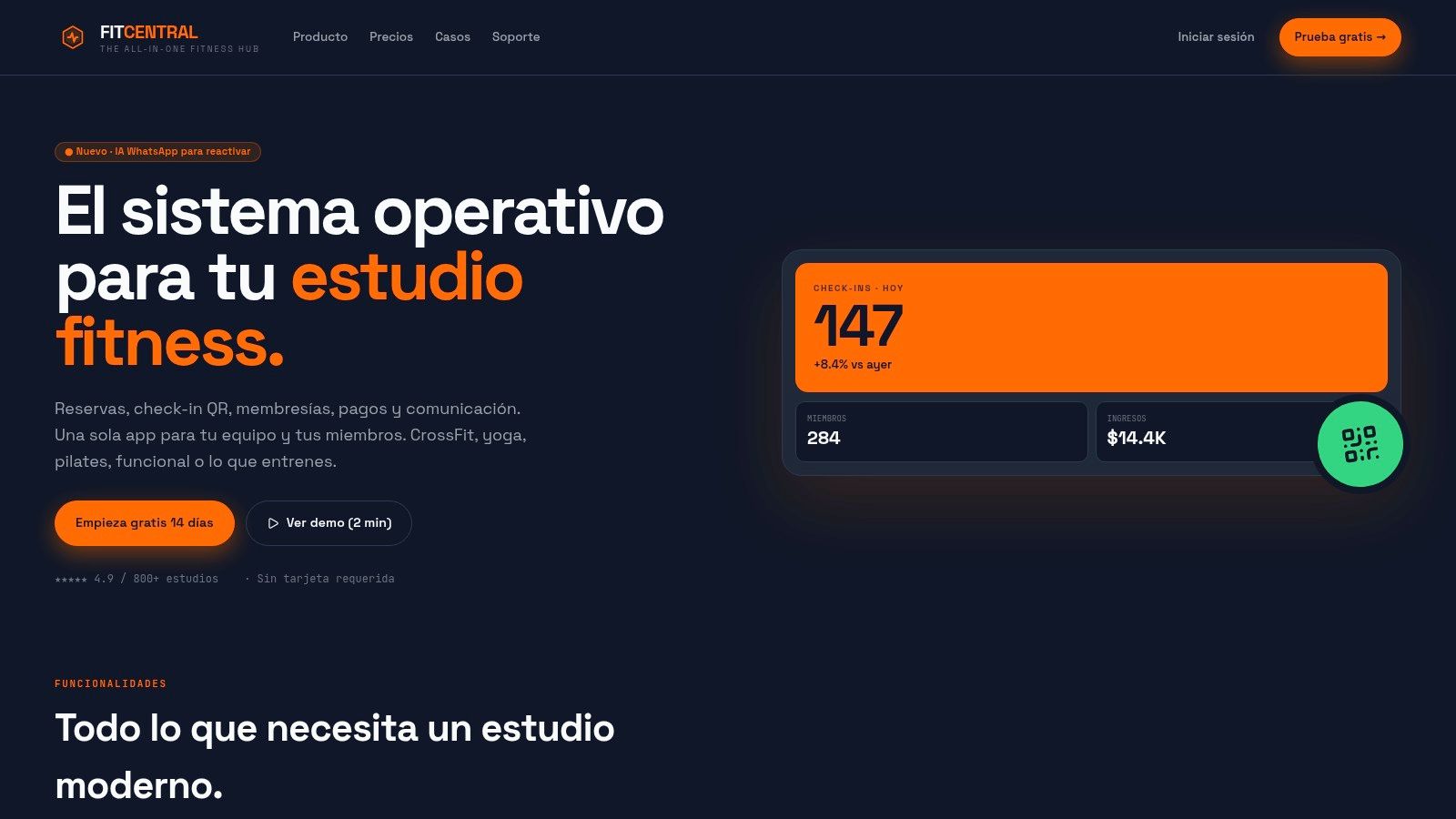
David Spitdowski, FitCentral's Co-Founder and a practicing personal trainer, built around exactly those problems. That matters because trainers can usually tell when software was designed by people who've never had to text a client about a failed payment.
Build an admin-light workflow
Your systems should do three jobs without drama:
Collect money automatically
Recurring payments are better than chasing invoices. If you want to tighten this up, this guide on how to set up recurring payments is worth reviewing.Let clients book inside real boundaries
Self-serve scheduling works when your availability is accurate and your rules are clear.Track sessions and notes in one place
If package counts, check-ins, and client communication live in different tools, things slip.
A cleaner workflow also makes premium pricing easier to defend. Clients notice when the experience feels organized.
Here's a quick look at what that can feel like in practice:
A polished coaching business doesn't just help you look professional. It protects time you can either sell, recover, or invest in better service.
A lot of coaches switch tools after getting burned by buggy apps, pricing that creeps upward, or support that stops answering once the sale is done. Reliability matters because every broken workflow gradually pushes your real hourly earnings down.
Answering Your Clients' Top Pricing Questions
You don't need a long speech when clients ask hard money questions. You need clear answers that protect your boundaries.
Short answers that protect your boundaries
“Why is your rate higher than a gym trainer?”
“Because independent coaching includes more than the session itself. Gym pay structures and independent pricing are very different, and there are real business costs behind professional coaching.” If you need context on the hidden economics, this walkthrough on how to get a certification in personal training also helps newer coaches understand why professionalism and pricing go together.
“Can you do a cash discount?”
“I keep the same pricing for every client and run payments through my normal system. It keeps things clean, consistent, and fair.”
“Why do you charge for late cancellations?”
“Because that time was reserved for you and usually can't be filled at short notice. The policy protects my schedule and keeps planning consistent for everyone.”
“Can I text you for extra help between sessions?”
“Yes, within the scope of your plan. That support is part of why my coaching is priced the way it is.”
One reason these questions come up is that clients don't see what you get to keep. One source notes that gym trainers may work on a 60/40 split and end up around $30 per hour before taxes, while an independent trainer charging roughly $75 per hour may keep only $30 to $50 per hour after expenses, which is why client-facing price and trainer take-home are not the same, as outlined in this breakdown of personal trainer hourly rates and take-home pay.
Keep your answers short. Calm beats defensive every time.
If you want your pricing model to hold up in real life, not just on paper, you need systems that support it. FitCentral gives coaches one reliable place to manage programming, scheduling, payments, progress tracking, and client communication without the usual mess of spreadsheets, chat threads, and software that gets worse after an acquisition. It was co-founded by David Spitdowski, a practicing personal trainer who still uses it daily, which is why the workflows truly match how coaches work. Your next step is simple. Audit your current offers, set your baseline rate, then make sure your billing and scheduling setup effectively protects that rate.
See also




Ready to stop fighting your software?
FitCentral gives you everything you need to manage clients, deliver results, and grow your business. Sign up today.