Personal Training Home: A Coach's Playbook for 2026
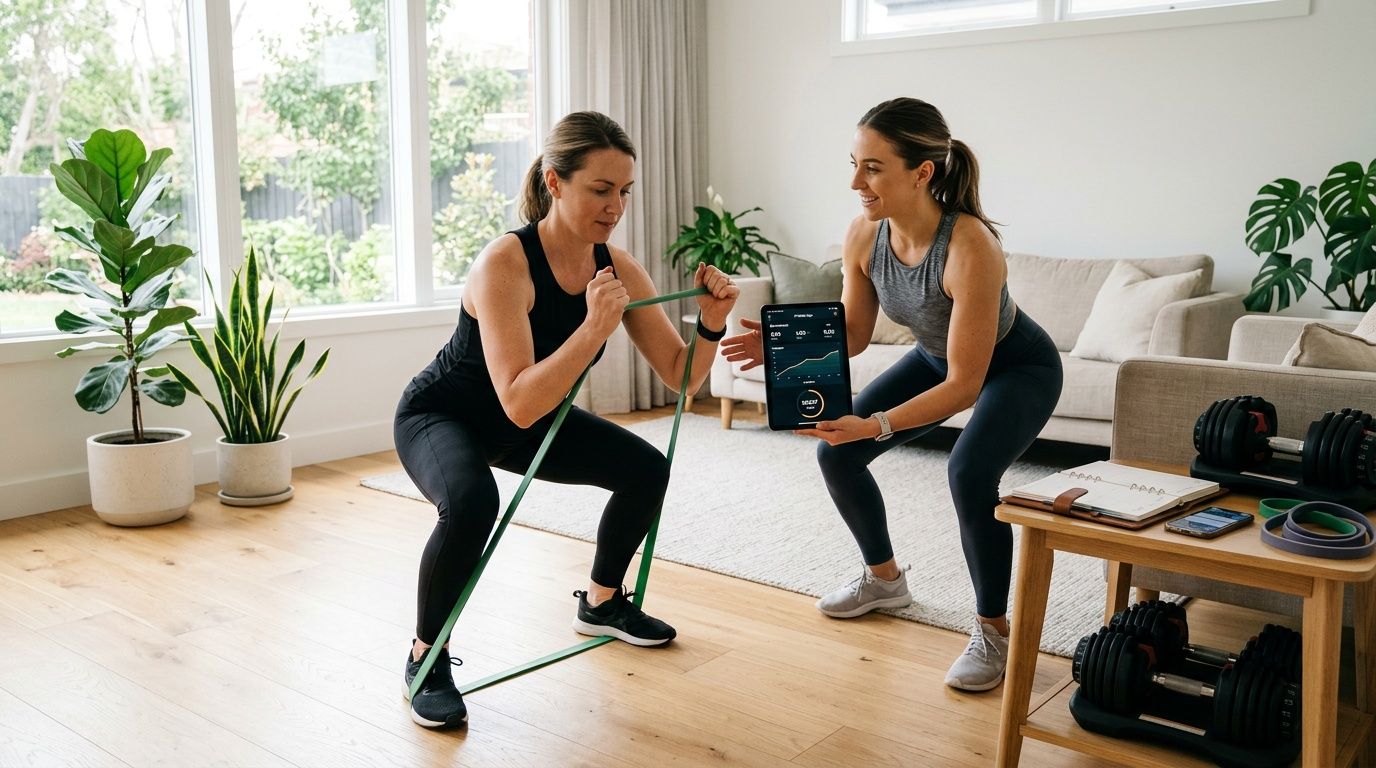
Your calendar looks full, but your day still feels loose. One client texts to move their session, another forgot to pay, a third wants tonight's workout, and you're checking three places just to confirm tomorrow's route. You got into personal training home because it gives clients a better experience. You stay because the work matters. But if the business side stays messy, you cap your income long before you cap your coaching skill.
That operational mess matters more than most trainers admit. IBISWorld's 2025 industry analysis notes that client's in-home services are now a core market segment, and the same analysis says 54% of clients prefer online or hybrid options while only 38% of trainers currently offer that blend. The opportunity is real. The bottleneck is usually not programming. It's systems.
Table of Contents
Fortifying Your Business From Day One
Build the legal base before you add clients
Use paperwork that matches in-home reality
The Modern In-Home Trainer's Kit
What belongs in your bag
What usually stays in the car for no reason
Programming Beyond the Squat Rack
Write programs around constraints, not around missing equipment
A simple hybrid week that actually scales
Automating Your Business From Onboarding to Payments
The manual version that drains your week
The automated version clients feel
Proving Value and Keeping Clients for Years
Visible progress keeps renewals simple
What to review every week
Your 24-Hour Action Plan
Fortifying Your Business From Day One
A lot of in-home trainers hit the same wall early. Sessions are going well, but the week still feels messy. A client reschedules by text, another forgets to pay, a waiver is buried in email, and now a simple calendar shift turns into twenty minutes of admin. That drag cuts into income long before coaching quality is the problem.
Build the legal base before you add clients
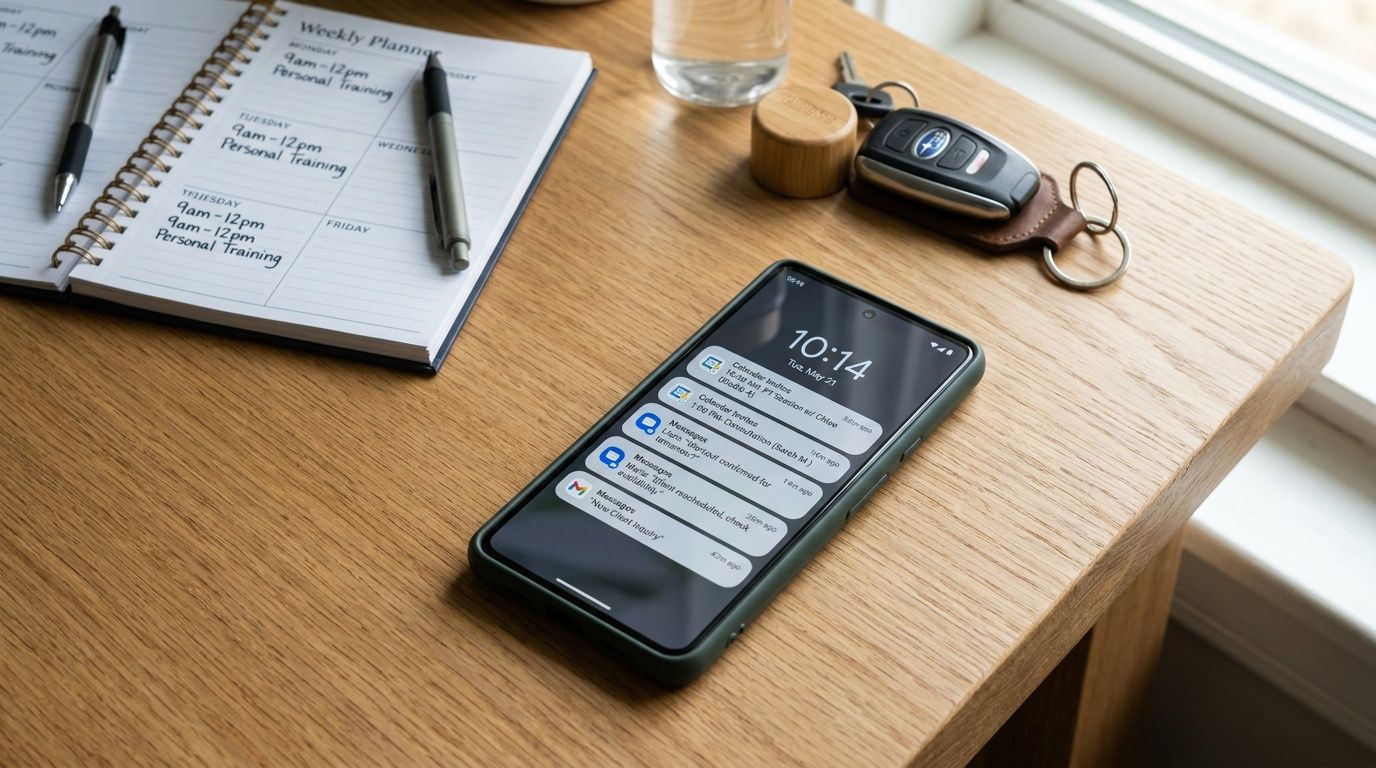
In-home work brings more variables than gym-floor coaching. You are driving to appointments, working around furniture, pets, stairs, flooring, and whatever equipment a client already owns. If the business side is loose, small issues turn into expensive ones fast.
Start with your business structure. Many trainers open as sole proprietors because it is fast and cheap. I understand the appeal. But once you are inside clients' homes and collecting recurring payments, cleaner separation between personal and business liability is usually worth the extra setup. An LLC can make that separation clearer, though the right choice depends on your state and tax situation.
Insurance needs the same level of attention. Do not assume a general fitness policy covers home visits the way you expect. Read the policy language and ask direct questions. Does it cover sessions in a client's residence? Does it cover injuries tied to your equipment, their equipment, or the training space itself? If a claim involves a driveway, staircase, or dog, vague wording will not help.
Use a simple operating standard:
Choose a business structure on purpose: Get state-specific advice before your roster grows.
Verify in-home coverage in writing: Ask the insurer to confirm that client-home sessions are covered.
Separate business money from personal money: Use a business bank account and process every session through it.
Keep records in one secure system: Waivers, invoices, session notes, and incident reports should be easy to find.
Practical rule: If a client disputed a charge or reported an injury today, could you pull the signed form, payment record, and session note in under a minute?
That is the standard to build around.
Use paperwork that matches in-home reality
Generic gym forms leave gaps. In-home paperwork should cover the training area, household equipment, health disclosures, emergency contacts, cancellation terms, payment authorization, and what happens between sessions if you offer remote programming or check-ins.
Good paperwork does more than reduce risk. It removes friction. Clients trust a process that feels clear from the first form to the first invoice. They also hesitate less when expectations are written down before scheduling gets complicated.
If you are still tightening the basics, this guide on personal trainer requirements for running a professional coaching business is a useful place to audit what is missing.
Hybrid and in-home demand are already part of the market. The trainers who benefit from that shift are not just better coaches. They run cleaner systems. They can schedule without text chaos, collect payments without chasing people down, and track client details without digging through old messages. That gap rewards trainers whose business is organized enough to support both.
The Modern In-Home Trainer's Kit
A lot of trainers waste energy trying to look “fully equipped.” They show up with too much gear, spend five minutes setting up, and still end up using the same few tools every session. That approach makes personal training home harder than it needs to be.
What belongs in your bag
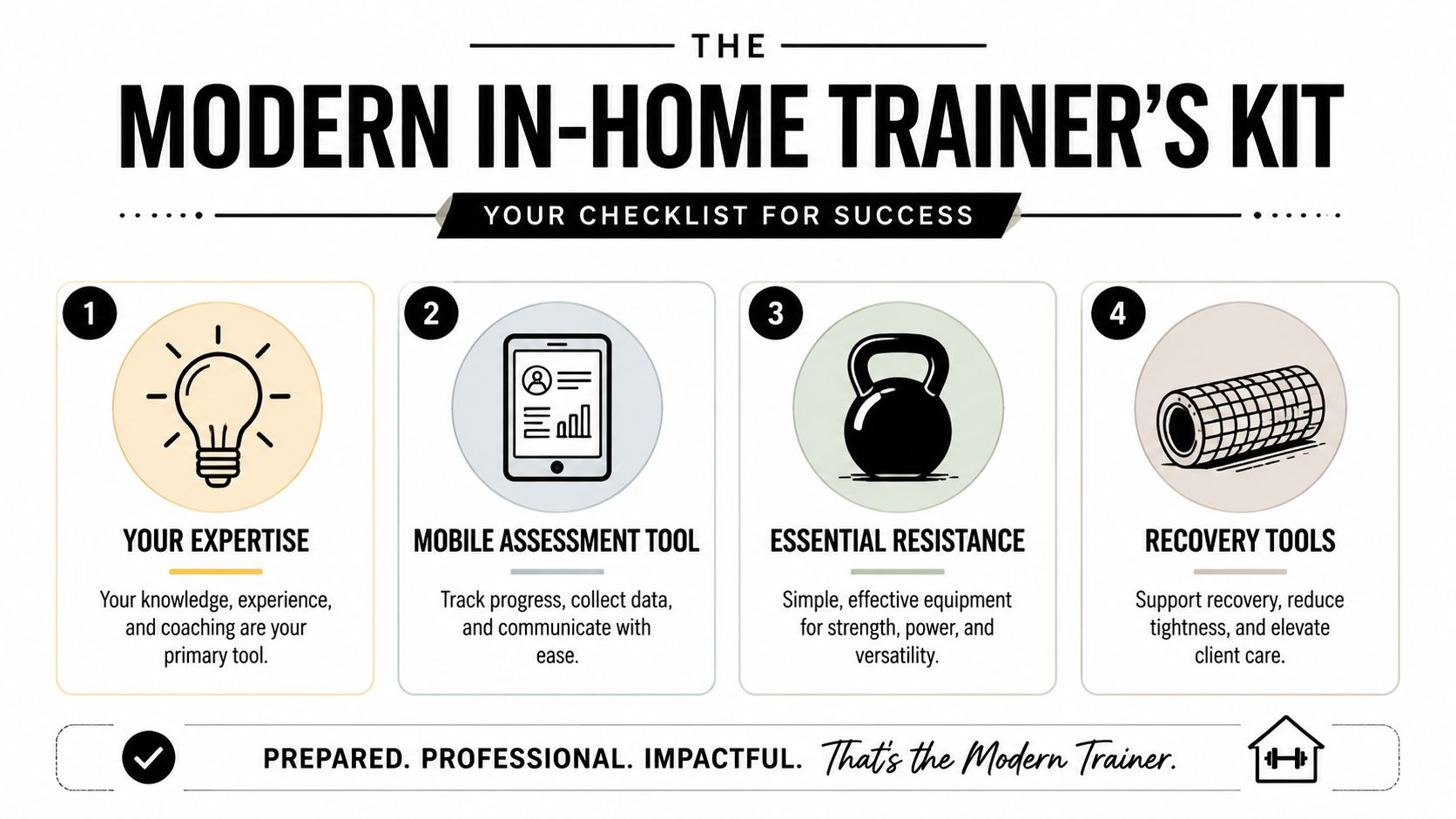
Your best asset is still your eye for movement, progression, and session control. The kit should support that, not compete with it.
A lean setup usually works better than a trunk full of options:
Bands you trust: Mini bands and longer resistance bands cover activation, rows, presses, assisted patterns, and travel-friendly overload.
One adjustable kettlebell or a compact heavy bell: Great for hinges, carries, goblet patterns, and complexes.
A suspension trainer: Fast setup, scalable bodyweight work, and useful across ability levels.
A timer and assessment tool on your phone or tablet: Session flow improves when rest, notes, and benchmarks live in one place.
Simple recovery add-ons: A lacrosse ball or compact mobility tool is enough for most sessions.
The point isn't to own less just for the sake of it. The point is to remove setup drag, transport fatigue, and decision clutter.
Bring equipment that solves programming problems, not equipment that proves you bought equipment.
What usually stays in the car for no reason
Some tools sound good until you carry them through three houses in one day.
Here's a quick sorting table:
Keep close | Use selectively | Usually not worth it |
|---|---|---|
Bands | Adjustable dumbbells | Large boxes |
Kettlebell | Sliders | Heavy med balls |
Suspension trainer | Portable bench | Multiple duplicate weights |
Tablet or phone for tracking | Foam roller | Bulky specialty tools |
What matters more than another piece of hardware is your digital kit. If clients train with you once or twice weekly, their results still depend on what happens between sessions. That means programming delivery, exercise demos, logging, messaging, check-ins, and habit visibility matter every day, not just during the hour you're in their living room.
Trainers who ignore the digital side usually end up rebuilding the same system with spreadsheets, note apps, and text threads. It works for a while. Then the roster grows, and the cracks show.
Programming Beyond the Squat Rack
If a client has one pair of dumbbells, some floor space, and inconsistent energy from a busy workweek, you still have enough to write excellent training. Personal training home gets stronger when you stop chasing perfect setups and start building around repeatable constraints.

Write programs around constraints, not around missing equipment
Most in-home programs improve when you organize progression through density, tempo, range, stability demand, and unilateral loading instead of chasing load jumps that the client can't make.
Three templates work well:
Escalating density blocks
Pick two non-competing movements and give the client a fixed work window. Keep form standards high and increase total quality work over time. This works especially well when available load is limited.Dumbbell or kettlebell complexes
String together hinge, clean, squat, push, and carry patterns. You get conditioning and strength endurance without turning the session into random fatigue.Advanced bodyweight progressions
Elevation changes, pauses, iso holds, offset loading, and tempo can make simple movements hard enough for strong clients.
Use tempo deliberately. The in-home environment gives you more room to coach details instead of rushing station to station. A cue like 3-1-1-0 can clean up control fast when clients tend to bounce through reps. It also makes lighter equipment more productive.
A good home session usually has:
One main pattern focus: hinge, squat, push, pull, carry, or single-leg emphasis
One progression target: density, rep quality, tempo, or complexity
One clear benchmark: total reps, time under tension, set quality, or reduced compensations
That's enough structure to drive progress without overcomplicating delivery.
A simple hybrid week that actually scales
A lot of trainers lose margin because they program hybrid support like they're giving away extra sessions. Don't do that. Build it as a system.
Concierge Personal Training's summary of 2025 market data notes that 35% of solo coaches saw rising demand for progress logging apps from in-home clients. It also cites an ACE Fitness study showing a 68% dropout risk without tracking, and says tools with set-by-set logging and habit tracking can boost retention by 25% for hybrid rosters. That tracks with what most experienced coaches already feel. If clients can't see progress between visits, they drift.
A scalable hybrid week can look like this:
Session 1 in person: assessment, technical work, progression updates
Session 2 in person or remote check-in: coaching, accountability, form review
Two independent app-delivered sessions: clear sets, reps, tempo, and rest
One habit target: steps, protein consistency, sleep routine, or recovery work
If you need client engagement ideas between sessions, these exercise challenge ideas for fitness coaches can help you keep momentum without adding random admin.
This walkthrough is a useful visual reference for coaching limited-equipment home sessions well:
Automating Your Business From Onboarding to Payments
A lead messages at 9:14 p.m. You reply after your last session. They answer the next morning while you are driving. By the time you both line up a consult, you have sent pricing, resent your waiver, checked your calendar twice, and still have not been paid. That is the part of personal training home coaches underestimate. The workouts are not what bury you. The handoffs do.
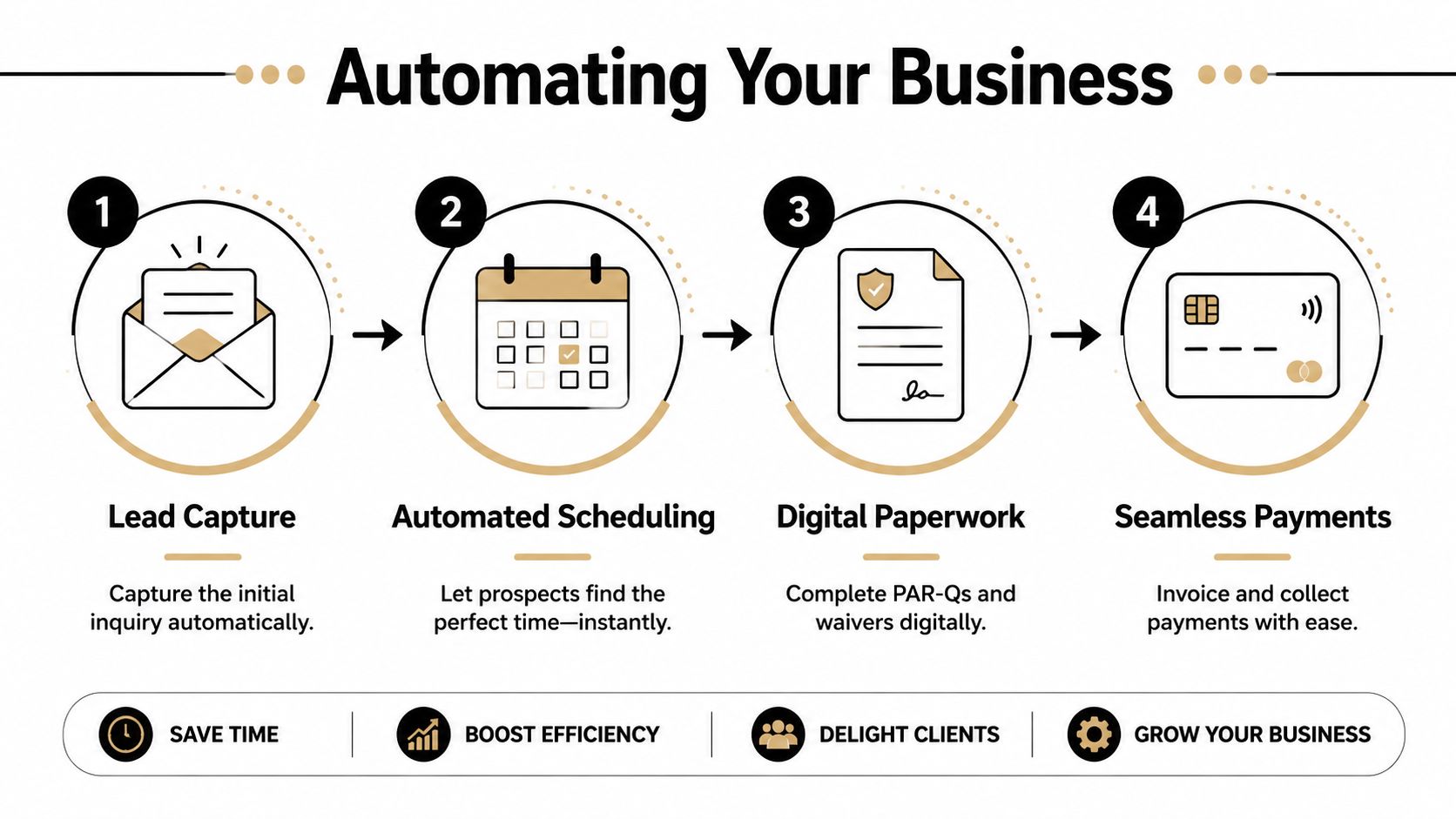
The manual version that drains your week
Most solo in-home trainers do not lose money because they coach poorly. They lose it in fragments. Five minutes to answer a scheduling text. Ten minutes to resend intake forms. Another few minutes to chase an unpaid invoice. Then a client forgets the session and your whole route breaks.
The cost is bigger for in-home work because every calendar mistake affects travel, session spacing, and the hour after it. A gym trainer might fill a gap. An in-home trainer usually cannot.
That is why I stopped treating admin like a side task and built a fixed client flow instead.
The automated version clients feel
The better setup is simple and strict.
A lead gets one booking link with two or three clear options. They pick a consult time from your real availability. Intake and waiver forms are completed before the first session, not after. Payment is collected upfront, or a package is authorized before recurring appointments begin. Reminders go out automatically. Session notes, program updates, and billing history stay in one place.
Clients feel the difference fast. They are not guessing what happens next. You are not rebuilding the process for every new person.
Here is what that changes in practice:
Scheduling stops living in text threads
Forms stop delaying the first paid session
Payments stop depending on your memory at the end of a long day
Your week becomes easier to route and protect
Clear systems make an in-home business feel more professional than constant back-and-forth ever will.
This is the build-out I recommend for most solo trainers:
Stage | Manual habit to remove | Better system |
|---|---|---|
Lead response | Text ping-pong | Booking link with fixed consult options |
Intake | PDF email chain | Digital PAR-Q and waiver before first session |
Scheduling | Hand-entered calendar | Calendar sync and client self-serve booking |
Reminders | One-off texts | Automated reminders tied to appointments |
Payments | Manual invoices | Recurring payments or prepaid packages |
If you are comparing software, this guide to the best personal trainer app options for coaches who need scheduling, client management, and payments is useful because it looks at workflow, not just feature lists.
One hard lesson here. Convenience can hide sloppiness. Too many tools promise an all-in-one fix, then force trainers into workarounds once real clients start rescheduling, pausing, splitting packages, or needing hybrid support. The better choice is usually the platform that handles your boring repeatable tasks well, even if it has fewer flashy extras.
That is the operational bottleneck for in-home coaching. If onboarding, scheduling, reminders, and payments depend on your attention every day, your income stays capped by admin before it is capped by demand.
Proving Value and Keeping Clients for Years
A client finishes her eighth in-home session, feels stronger, and still asks, “Do you think this is working?” That question usually means the coaching is fine, but the proof system is weak.
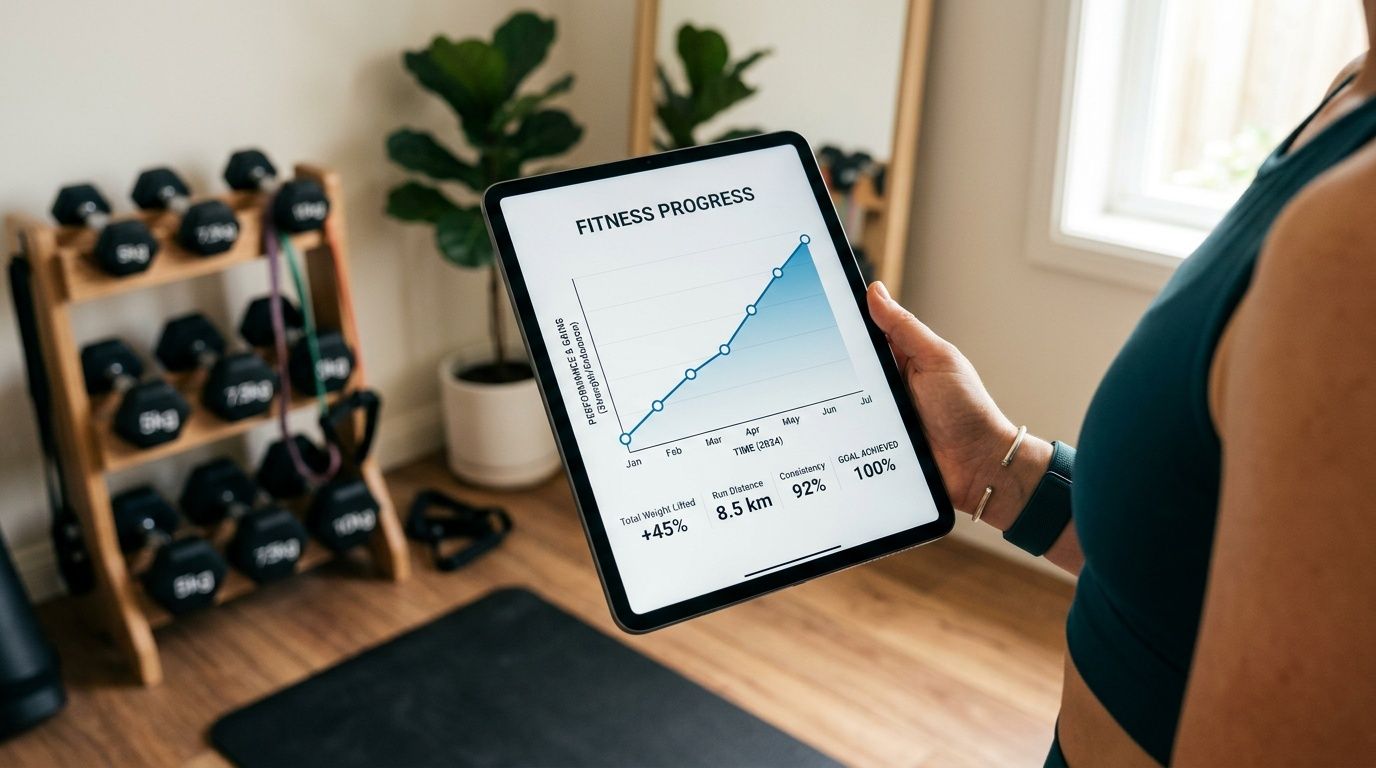
In-home trainers lose clients when progress stays trapped inside session notes, memory, or casual comments during cooldown. Retention gets stronger when clients can see what improved, why it improved, and what comes next.
Visible progress keeps renewals simple
Home sessions give trainers an advantage on movement quality because the session is quieter, more focused, and easier to coach rep by rep. Triat Fitness notes that in-home coaching can reduce form errors by 20-30%, and that tracking plus tempo coaching like 3-1-1-0 can help clients achieve 15-25% monthly improvements in key lifts, while consistent logging can improve adherence by 40%.
Those numbers matter, but the bigger point is practical. Clients stay longer when improvement is easy to spot.
I use five forms of proof most often:
cleaner reps on video or side-by-side notes
better control at the same load
improved work capacity across the same session format
benchmark numbers that trend up over time
photos that match what the client has been feeling
That mix works because it covers both performance and real life. A client might care less about a goblet squat number than the fact that stairs feel easier, their back stops barking by 3 p.m., or they can get off the floor without bracing on furniture.
If progress is not documented, many clients assume it is not happening.
What to review every week
Weekly reviews should be short enough to maintain and clear enough that the client remembers them. If the check-in takes too long to prepare, it will slip. If it is too vague, it will not help retention.
Use a four-part review:
Performance marker
One lift, one bodyweight movement, or one conditioning metric.Adherence marker
Sessions completed, walks hit, protein target met, or home assignments done.Recovery note
Energy, soreness, sleep, schedule friction, or stress that changed the week.Next adjustment
Increase load, add reps, tighten tempo, swap an exercise, or reduce volume.
That structure keeps the conversation grounded. It also protects your time. Instead of rebuilding the client's story from scratch every month, you have a simple record that shows what changed and why.
Nutrition and recovery belong in that review too, especially if you coach between visits. If you want a simple way to make food habits visible without turning check-ins into calorie debates, this guide to a nutrition tracking app for coaches managing client habits is useful.
Long-term retention usually comes from a few repeatable habits done well:
Use progress photos with rules: same lighting, same poses, same timing
Track fewer metrics: pick the measures that affect decisions
Show trends over snapshots: clients need direction, not random data points
Translate training into daily wins: pain, energy, mobility, confidence, and routine count too
The operational benefit is easy to miss. Clear tracking reduces awkward renewal conversations, cuts down on reassurance texting, and makes program changes faster because you are working from records instead of guesswork.
Clients do not pay for sessions alone. They pay for momentum they can recognize.
Your 24-Hour Action Plan
You do not need a full rebrand or a giant systems overhaul this week. You need a few clean decisions.
Audit your client journey
Write down every step from inquiry to first paid session. Circle anything that still depends on manual texting, separate documents, or memory.Fix one scheduling bottleneck
Set specific consult slots or training windows instead of offering open-ended availability. That alone cuts a lot of back-and-forth.Standardize your first-session workflow
Use one intake form, one waiver, one assessment flow, and one follow-up message for every new client.Choose three progress markers per client
Pick one performance metric, one habit metric, and one visual marker. Track those consistently before adding anything else.Remove one piece of gear from your car
If you haven't used it in weeks, it's probably costing you more in setup friction than it gives back in coaching value.Pre-build one hybrid training week
Create a repeatable template with one in-person session, one support check-in, and independent work delivered clearly between visits.Upgrade one trust signal
Tighten your waiver, payment policy, or intake sequence. Professionalism closes more renewals than clever social content.Review your brand touchpoints
If your first impression still feels homemade, update the basics. Even something as small as sharper collateral can help. These fitness trainer business card ideas are useful if you still hand prospects something forgettable.
Pick two items and finish them today. Not research them. Finish them.
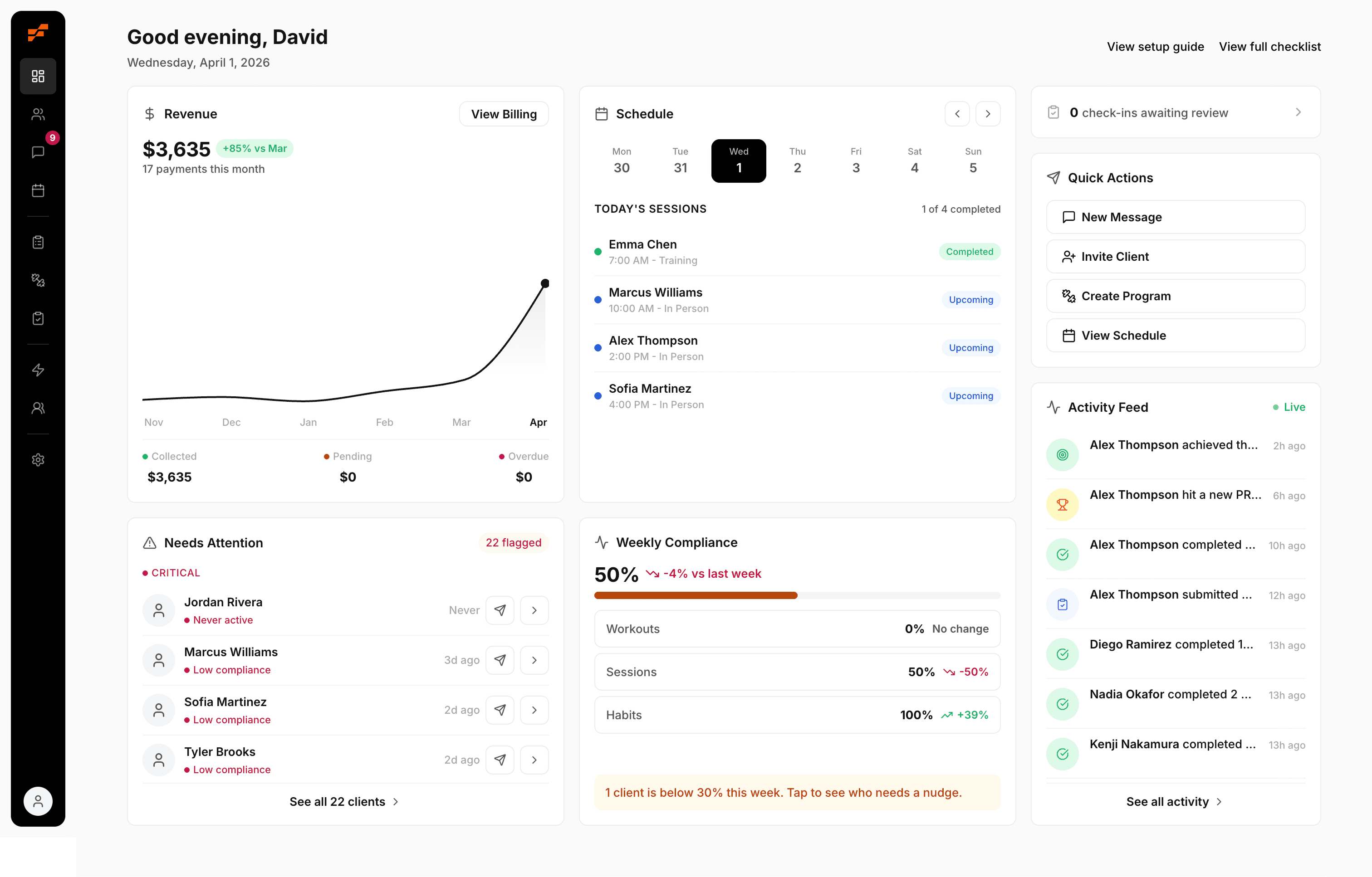
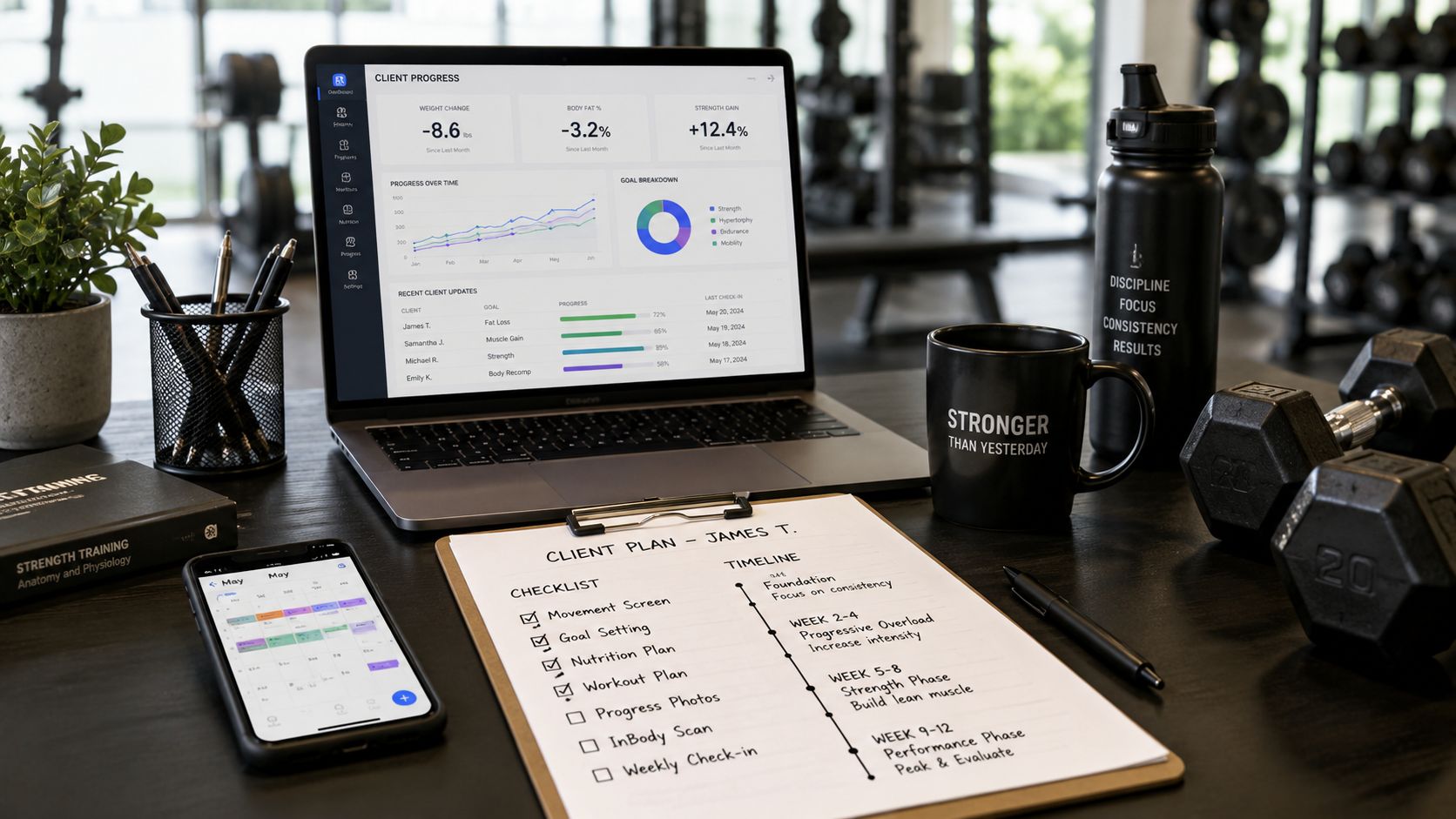
If your business is held together by spreadsheets, text threads, and reminders you have to remember yourself, FitCentral gives you a cleaner way to run personal training home. You can manage programming, scheduling, progress tracking, messaging, habits, and payments in one reliable system built for coaches by a practicing trainer. If you want fewer admin fires and more coaching time, that's the next step.
See also


Ready to stop fighting your software?
FitCentral gives you everything you need to manage clients, deliver results, and grow your business. Sign up today.