Macronutrients and Weight Loss: A Coach's Practical Guide
A client is hitting calories, logging meals, and showing up for every session. The scale is moving, but the look you both wanted isn't showing up. Strength is flat, hunger is climbing, and progress photos look softer instead of tighter.
That's usually where coaches stop blaming compliance and start looking at macronutrients and weight loss as a coaching system, not just a math problem. Calories still matter. But once a client is in a deficit, the split between protein, carbohydrates, and fats starts affecting satiety, training quality, muscle retention, and whether the plan is even sustainable across a full roster.
Table of Contents
When Calorie Counting Is Not Enough
What coaches usually miss
The Role of Each Macronutrient in a Deficit
Protein preserves lean mass and makes the diet easier to hold
Carbohydrates support output, recovery, and adherence
Fats keep meals workable and the plan livable
Setting Practical Macro Targets for Your Clients
Start with protein, then build around the client
Client Macro Targets by Goal
Don't ignore food quality
A Step-by-Step Macro Calculation Walkthrough
Sample client and calorie setup
Convert calories into macros
Coaching Macros Beyond the Numbers
Turn vague complaints into clear adjustments
Build habits that make macro adherence easier
Use tools to coach adherence, not just intake
Protect against hidden nutrition gaps
Common Questions and Your Next Action
How do you count alcohol
How often should you adjust macros
Do clients need perfect macro compliance
What should you do in the next 24 hours
When Calorie Counting Is Not Enough
You've seen this client before. She's consistent, honest in check-ins, and implements the strategies. Calories are on target. Sessions are done. Weight is trending down. But the result is the wrong kind of progress.
That's the limit of calorie-only coaching. It explains weight change, but it doesn't fully explain body composition, hunger, recovery, or performance inside a deficit.

A client can hit calories with low protein, poor meal structure, and weak food quality. On paper, that looks compliant. In practice, you get more hunger, worse training sessions, and a higher chance that the weight lost isn't the look the client is paying for.
What coaches usually miss
When calorie counting stops giving clean answers, these are the first places I'd check:
Protein intake is too low: The client is losing weight, but not holding muscle well.
Carbs are poorly placed: Training sessions feel flat, and effort drops before volume does.
Fats are random: Meals don't satisfy, and appetite swings become harder to manage.
Food logging lacks context: The calorie total is accurate enough, but the pattern behind it is a mess.
Practical rule: When a client says, “I'm hitting my calories,” ask, “What are those calories made of, and when are they showing up?”
That's why macro coaching works better than calorie coaching alone. You're not replacing energy balance. You're tightening the variables that decide whether a deficit feels productive or punishing.
If you want a simple way to spot this fast, use a free nutrition tracking app breakdown for coaches and review meal patterns, not just totals. Most “mystery plateaus” and “bad body comp outcomes” stop being mysterious once you look at the actual split.
The Role of Each Macronutrient in a Deficit
A client starts a cut with clean calorie targets, solid motivation, and decent compliance. Two weeks later, hunger is up, training feels flat, and food focus is getting louder. The calorie deficit is still there. The macro split is usually where the plan starts breaking down.
Macros are not interchangeable in a deficit. They change how the deficit feels, how well the client trains, and how much muscle they keep while body weight drops. The acceptable macro distribution range for adults, published by the National Academies, gives a useful boundary of 45 to 65% of calories from carbohydrate, 20 to 35% from fat, and 10 to 35% from protein in the Dietary Reference Intakes report from the National Academies. That is a guardrail, not a coaching prescription.
Protein preserves lean mass and makes the diet easier to hold
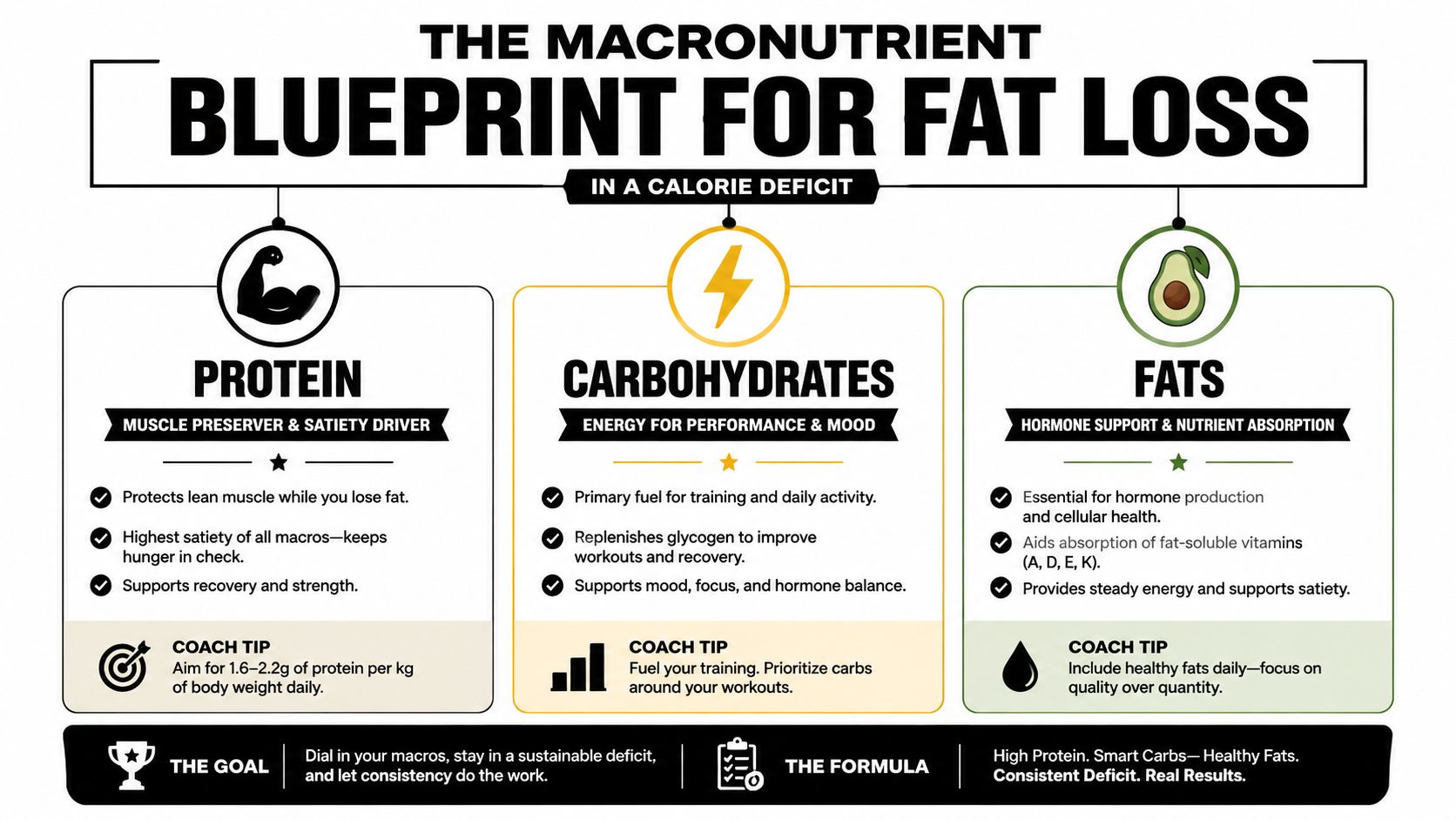
Protein is the first macro I secure because it solves two common fat loss problems at once. It helps retain lean mass while calories are low, and it usually improves appetite control enough to make the plan more stable.
The International Society of Sports Nutrition states that higher protein intakes are often appropriate for physically active people who want to maintain or build lean mass, especially during periods of energy restriction, in its position stand on protein and exercise. In coaching terms, this matters because clients do not judge a cut by scale loss alone. They judge it by whether they still look trained, whether recovery holds up, and whether they can get through the week without white-knuckling every meal.
Protein also gives structure to the day. A client with a clear protein target usually builds better meals by default. A client with only calories often builds snacks.
If you need a practical reference for meal-level planning, these macro examples for common foods and meals make it easier to turn a protein target into repeatable choices.
Carbohydrates support output, recovery, and adherence
Carbohydrates are the macro I adjust most often after protein because they directly affect training quality. Low carbs do not bother every client, but they show up fast in people doing hard lifting, higher-volume training, sport practice, or long active days.
The American College of Sports Medicine, the Academy of Nutrition and Dietetics, and Dietitians of Canada note in their joint position paper on nutrition and athletic performance that carbohydrate has a central role in supporting training demands and performance. For fat loss coaching, that does not mean every client needs high carbs. It means poor training, low drive, and repeated energy crashes should not be treated as motivation issues before you review carbohydrate intake and timing.
A scalable system matters in this context. Instead of arguing about low carb versus high carb, review three things first: the client's training demand, where carbs are placed across the day, and whether intake drops hardest on the days they need performance most. That process catches more problems than debating ideology.
Fats keep meals workable and the plan livable
Dietary fat becomes important when calories get tighter. It slows meals down, improves satisfaction, and helps the diet feel like normal eating instead of macro math.
The trade-off is simple. Push fat too low and many clients get less meal satisfaction, more grazing, and worse adherence. Push it too high and it gets harder to keep calories controlled while still leaving enough room for protein and carbs.
In practice, fats are the stability macro. They often determine whether a client feels calm between meals or starts picking at food all evening. They also matter for food quality, because many nutrient-dense staples, including eggs, salmon, dairy, nuts, seeds, olive oil, and avocado, bring fat with them.
Good macro coaching uses all three macros for different jobs. Protein protects lean mass and satiety. Carbohydrates protect performance and training quality. Fats protect meal satisfaction and long-term compliance. Once you coach them that way, food logs become more useful, troubleshooting gets faster, and tracking tools start serving the plan instead of running it.
Setting Practical Macro Targets for Your Clients
A client can hit calories, log every meal, and still stall because the macro setup does not match how they eat. That is usually a systems problem, not a motivation problem.
Set macros in an order that makes coaching easier to scale. Start with protein. Set a fat minimum that keeps meals satisfying and realistic. Then use carbohydrates as the adjustment variable based on training load, food preference, schedule, and adherence history. That order gives coaches a cleaner way to troubleshoot check-ins, food logs, and missed targets.
Start with protein, then build around the client
Protein is the anchor. It supports satiety, helps preserve lean mass during a deficit, and makes the plan easier to hold when calories get tight. The general adult minimums often cited in public health guidance are only a floor. They are not a useful coaching target for fat loss clients.
For practical setup, use a protein range of 1.2 to 2.0 g/kg and place the client inside that range based on context. Clients with a large deficit, a high hunger profile, or a strong body composition goal usually do better higher in the range. Clients with low appetite, lighter training, or a harder time fitting protein into their routine may start lower and build up.
After protein, set fats and carbs based on execution, not ideology. The Acceptable Macronutrient Distribution Range from the National Academies gives coaches reasonable guardrails for adult intake: 20 to 35 percent of calories from fat and 45 to 65 percent from carbohydrate in healthy adults, as outlined by the National Academies' Dietary Reference Intakes report.
Client Macro Targets by Goal
Client Profile | Protein (g/kg) | Fat (% of Calories) | Carbohydrates (% of Calories) |
|---|---|---|---|
General Population Fat Loss | 1.2-2.0 | 20-35% | 45-65% |
Lean Muscle Gain Phase | 1.2-2.0 | 20-35% | 45-65% |
Performance-Focused Athlete | 1.2-2.0 | 20-35% | 45-65% |
The table stays simple on purpose. A scalable coaching system needs ranges you can apply quickly, then adjust from check-in data.
Use a practical filter:
General population fat loss: Push protein higher if hunger, snacking, or muscle retention are clear concerns.
Lean muscle gain phase: Keep protein steady and give carbs more room if training performance or recovery is lagging.
Performance-focused athlete: Keep fat adequate, then protect carbohydrate intake so output and recovery do not slide.
For coaches who want faster setup references, this macro examples for different goals resource is useful when building first-draft targets.
Don't ignore food quality
Macro numbers alone do not fix adherence. The food choices underneath them decide whether the target feels manageable on a Tuesday night after a long day of work.
Large prospective research and review data have shown a consistent pattern. Higher-fiber eating patterns are associated with better weight control over time, and diets built around minimally processed foods tend to make intake easier to regulate than diets built around highly processed foods. The Harvard T.H. Chan School of Public Health fiber overview is a solid reference when you need a simple explanation for clients.
In practice, this is one of the fastest troubleshooting wins in macro coaching. If a client is technically hitting protein but still reports constant hunger, poor fullness, and evening overeating, check meal composition before changing calories. Look at fiber, food volume, liquid calories, and how often their carbs are coming from foods that disappear fast and satisfy poorly.
Coach's shortcut: If a client hits macros on paper but feels hungry all day, audit food quality, meal structure, and tracking accuracy before you lower calories.
That approach scales well. It works whether the client uses a full food scale, a photo log, or an app with barcode scanning and saved meals. The macro target sets the direction. The coaching system, habits, and tracking tools determine whether the client can follow it for more than a week.
A Step-by-Step Macro Calculation Walkthrough
Coaches overcomplicate macro setup when they jump straight to ratios. Start with calories, then assign macros in order.
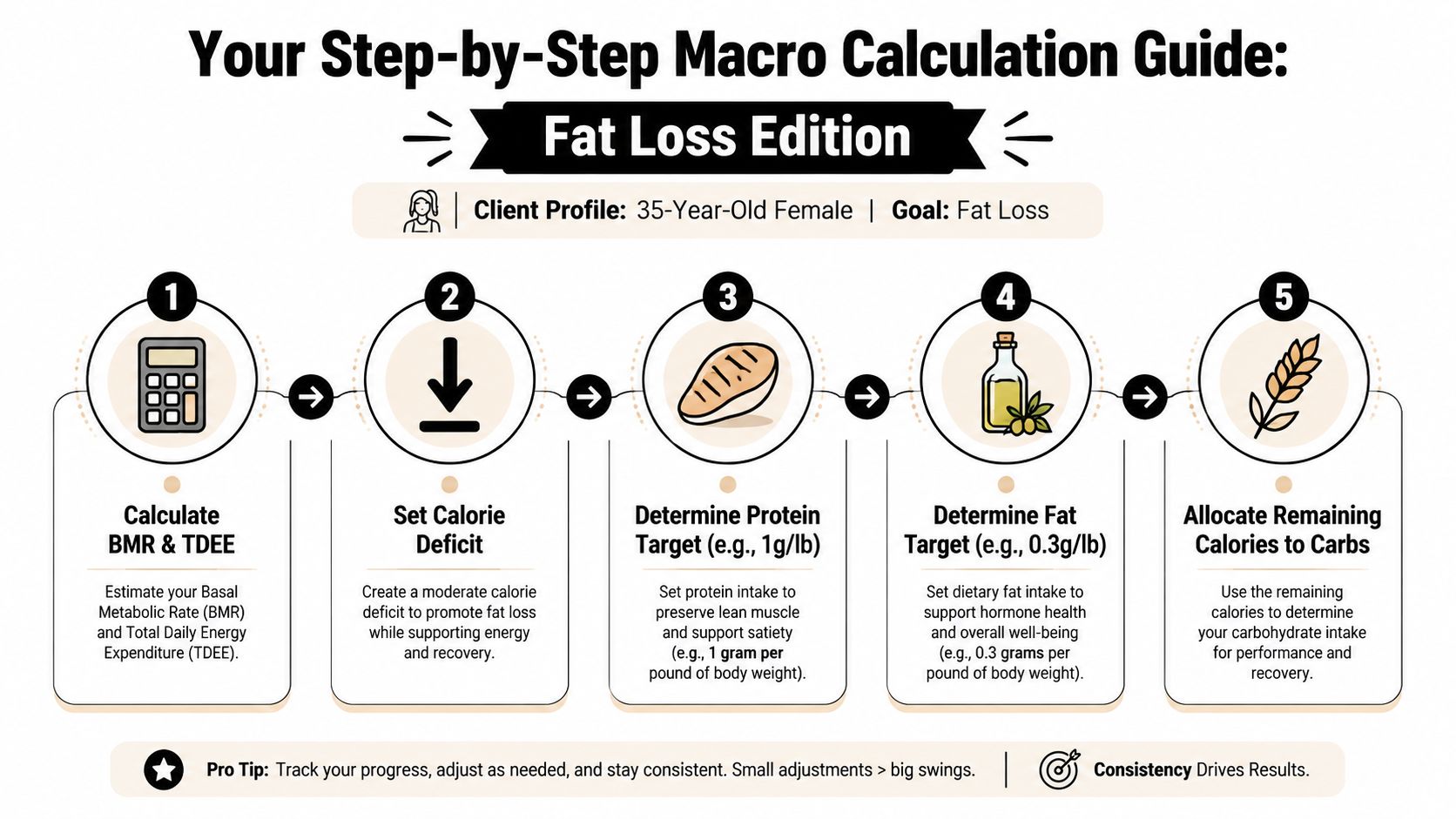
Use this as a clean example for a hypothetical 35-year-old female client whose goal is fat loss. We'll use the Mifflin-St Jeor equation and a moderate activity multiplier.
Sample client and calorie setup
Assume she weighs 70 kg, is 165 cm tall, and is 35 years old.
Calculate BMR
Mifflin-St Jeor for women:
BMR = 10 × weight (kg) + 6.25 × height (cm) – 5 × age – 161Her result:
(10 × 70) + (6.25 × 165) – (5 × 35) – 161 = 1,454 caloriesEstimate TDEE
If she's moderately active, use 1.55.1,454 × 1.55 = 2,254 calories
Set the deficit
Use a moderate cut. In this example, use 15%.2,254 × 0.85 = 1,916 calories
Before you assign grams, make sure the calorie target is something the client can execute. A mathematically perfect number that leads to missed meals, snack rebounds, and weak sessions isn't useful.
A quick visual helps when you're explaining this in a consult:
If you want a cleaner workflow for storing nutrition targets and check-ins, a nutrition coaching app guide for personal trainers can help you standardize the handoff.
Convert calories into macros
Now assign macros in a practical order.
Set protein first
Use a high-protein target inside the evidence-based range. For this example, set protein at 140 g.Protein calories:
140 × 4 = 560 caloriesSet fats next
Place fat within the AMDR. For this example, use 30% of calories from fat.Fat calories:
1,916 × 0.30 = 574.8 calories
Fat grams:
574.8 ÷ 9 = 63.9 gRound to 64 g.
Give the rest to carbohydrates
Remaining calories:
1,916 – 560 – 574.8 = 781.2 calories
Carb grams:
781.2 ÷ 4 = 195.3 gRound to 195 g.
That gives you a workable starting point:
Protein: 140 g
Fat: 64 g
Carbohydrates: 195 g
Calories: about 1,916
Don't sell this as the perfect answer. Sell it as the first useful answer. The client's hunger, performance, recovery, and trend data will tell you what needs adjusting next.
Coaching Macros Beyond the Numbers
A client can leave a consult with clean numbers, a solid calorie target, and macros that make sense on paper. By Tuesday night, they are ordering takeout, missing protein, and telling you the plan is too hard to follow. That gap is where coaching systems matter.
Macro coaching works best when it is repeatable for you and realistic for the client. The goal is not tighter spreadsheets. The goal is better adherence, faster troubleshooting, and a setup you can scale across a full roster without guessing every week.

Turn vague complaints into clear adjustments
Client feedback usually sounds emotional first and specific second. Good macro coaching means translating that feedback into a short diagnostic process your team can use every time.
If a client says they are hungry all day, check food logs before you change targets. Low protein is one possibility, but so is poor meal timing, low fiber, long gaps between meals, or spending calories on foods that do not keep them full. If training feels flat, look at total carbs, carb timing, sleep, and whether the client is under-eating because their logging accuracy slipped. If evenings keep falling apart, I usually audit the first half of the day before touching dinner.
A simple troubleshooting framework helps:
“I'm always hungry”
Review protein intake, meal volume, fiber sources, and meal spacing.“My workouts feel weak”
Check carb intake around training, total calorie intake, and recovery habits.“I do well all week, then lose control on weekends”
Audit the structure, not just the target. The plan may be too rigid for social meals, family routines, or unplanned eating.“My weight is dropping, but I look flatter or softer”
Recheck protein, training quality, recovery, and whether the deficit is too aggressive.
The food log usually gives you more than the check-in form. Patterns show up fast when clients log enough for you to see missed meals, low-protein choices, restaurant drift, and the times of day where structure breaks.
Build habits that make macro adherence easier
Tracking fatigue is predictable. Clients do not fail because they forgot what protein, carbs, and fat are. They fail because the plan asks for too many good decisions during a normal week.
Use habits to reduce decision load.
Start with repeatable meals. A standard breakfast and one or two fallback lunches remove a lot of friction. For many clients, dinner is the highest-risk meal, so plan that one first. Give them default options for late workdays, travel, and family meals. A short list of macro-friendly foods for busy clients and coaches helps more than another lecture on tracking accuracy.
Then layer habits in a sequence the client can maintain:
Lock in one protein-forward breakfast
Pre-log or pre-decide dinner
Add one reliable backup meal for chaotic days
Tighten snack choices only after meals are stable
That order matters. Coaches lose clients when they push precision before they build consistency.
Use tools to coach adherence, not just intake
Modern tracking tools are useful because they shorten the distance between what happened and what you can fix. The app is not the coaching. The app gives you enough visibility to coach with accuracy.
What helps is a simple review process. Look for missed meals, repeated substitutions, low-protein restaurant entries, large untracked periods, and whether the client hits calories by saving too much for the end of the day. Those patterns tell you whether the next move is a macro change, a meal structure change, or a compliance problem.
I prefer systems that keep this review fast. If it takes 20 minutes to understand one food log, the process will break as your roster grows.
Protect against hidden nutrition gaps
Macro compliance can still hide a weak food pattern. A client can hit targets with shakes, bars, and low-variety meals, then wonder why energy, digestion, and training quality start slipping.
A better coaching standard is to check macro adherence and food quality at the same time. Protein variety matters. Plant intake matters. Fat sources matter. Restrictive setups need closer review because they increase the risk of missing key nutrients.
That concern showed up in a 2010 randomized trial published in Nutrition Journal comparing Atkins, Zone, LEARN, and Ornish diets for nutrient adequacy. In practice, the lesson is simple. The tighter and narrower the food pattern, the more carefully you need to monitor what the client is no longer eating.
Use a quick quality screen during check-ins:
Protein source variety: Include more than powders, bars, and processed convenience foods.
Plant coverage: Get fruits, vegetables, legumes, and whole grains in where they fit.
Fat quality: Include foods that bring micronutrients and satiety, not just calories.
Restriction review: The more rules a client follows, the closer you should watch for gaps.
Strong macro coaching is a system. Set targets, build habits that support them, review logs for patterns, and adjust based on real behavior. That approach holds up far better than handing over numbers and hoping the client can figure out the rest.
Common Questions and Your Next Action
A few questions always come up once clients start tracking.
How do you count alcohol
Keep it practical. Alcohol adds energy, and it also tends to pull clients off structure through food choices, poor sleep, and loose decision-making. I'd account for it inside the client's weekly intake, then coach the downstream behavior, not just the calories.
How often should you adjust macros
Adjust only after you have enough data to know whether the plan is failing. Don't rewrite targets because of a rough weekend or a single weigh-in. Look for a real pattern in adherence, training quality, appetite, and progress trend.
Do clients need perfect macro compliance
No. They need consistency strong enough to create a useful signal. If the client can't follow the plan with reasonable accuracy, the first fix is usually simplification, not more precision.
What should you do in the next 24 hours
Pick one plateaued client on your roster. Recalculate their calories and macros using the walkthrough above. Then book a short call and explain the why behind the changes in plain language.
If you want another perspective on what strong nutrition coaching looks like in practice, review how the top nutrition coaches build trust and systems. Then apply one idea immediately.
A macro plan only matters once the client can follow it.
FitCentral gives you one place to run that whole system, from nutrition logging and habit tracking to check-ins, progress photos, workouts, scheduling, messaging, and payments. It was co-founded by David Spitdowski, a practicing trainer who still works with real clients, so the workflow reflects what coaches need. If you're tired of software with buggy apps, rising prices, and feedback that disappears, see how FitCentral helps you coach macros with more clarity and less admin.
See also



Ready to stop fighting your software?
FitCentral gives you everything you need to manage clients, deliver results, and grow your business. Sign up today.